
Lighting: Real life outlines!
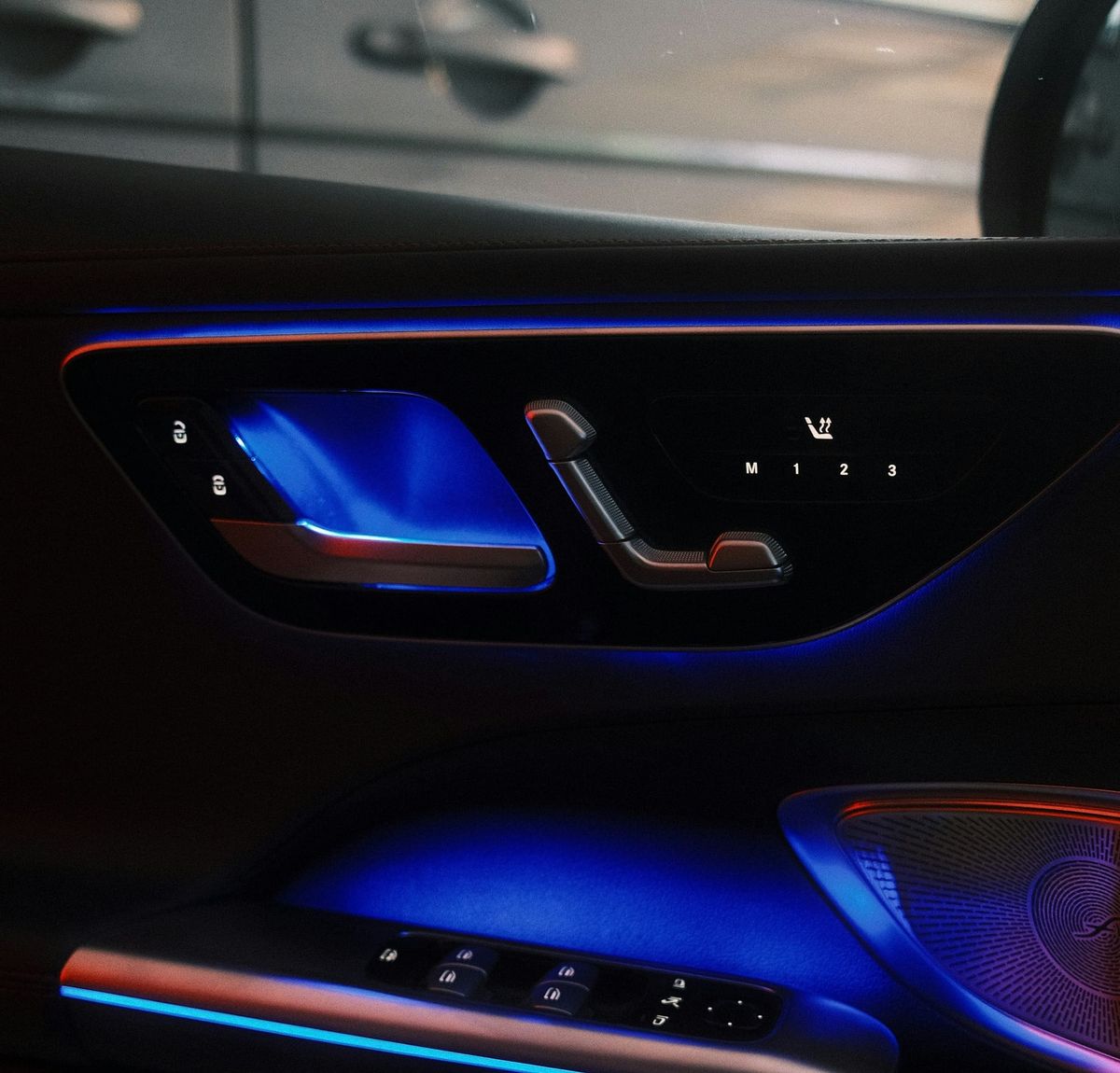
Ambient lighting provides low-level illumination around features such as door handles, cupholders, consoles, and footwells. In Ambient Lighting Makes Drivers Feel Safer, Bird (2018) discusses research by BMW and Ilmenau University of Technology examining how this lighting changes the perception and usability of an interior.
Drivers perceived illuminated interiors as more spacious at night, judged materials and design more favorably, and found controls easier to use. These findings connect ambient lighting with spatial awareness and perceived quality (Bird, 2018).
Lighting accentuates surfacing. Edges, recesses, and touch points become details that someone can identify within a dim space. I think the placement of that light deserves attention. A strip following a dashboard emphasizes its shape, while illumination around a door handle could help someone identify where to reach. These serve different purposes, even if both are described as ambient lighting.
I think back to using a harsh overhead light to find something in the cabin. It illuminates a broad area, while what I actually need might be a clearer view of one storage pocket. This makes me interested in how much useful information a smaller, more deliberately placed light could provide. Similar to an 'outline' or 'contour' in an illustration, ambient lighting can 'bring a design' to life. A halo behind a mounted television might give a floating effect. The human vision relies on light as the absence or presence of information; and that intersects with
Excessive brightness became distracting, and drivers wanted control over illumination levels. The report also discusses glare on interior plastics. Findings about improvements in alertness, mood, and driving performance remained inconclusive (Bird, 2018).
This gives me a more specific way to evaluate ambient lighting: what it reveals, where it reflects, and whether its intensity suits the task. I would want to compare a light that illuminates a handle with one that shines directly toward the person reaching for it. Both could make the handle visible, but their comfort would need to be assessed from the person's actual seating position. The placement of the source, the surface receiving the light, and the viewing angle all become questions to test.
Reflection
I think this reading is useful because it gives me something more specific to examine than whether an interior looks appealing. I would want to test whether someone can locate a handle, identify a storage opening, or return an object under different lighting conditions. The time taken, mistakes, and brightness preferences could help explain which arrangement works for that task. I would also look at reflections from each seating position, especially on glossy surfaces. This makes ambient lighting feel like a part of the interaction with a space, something that should be evaluated while people are actually moving through it.
Reference
Bird, C. (2018, September 24). Ambient lighting makes drivers feel safer. Cars.com. Read the article.



