
Mushrooms: Plastic Replacement?
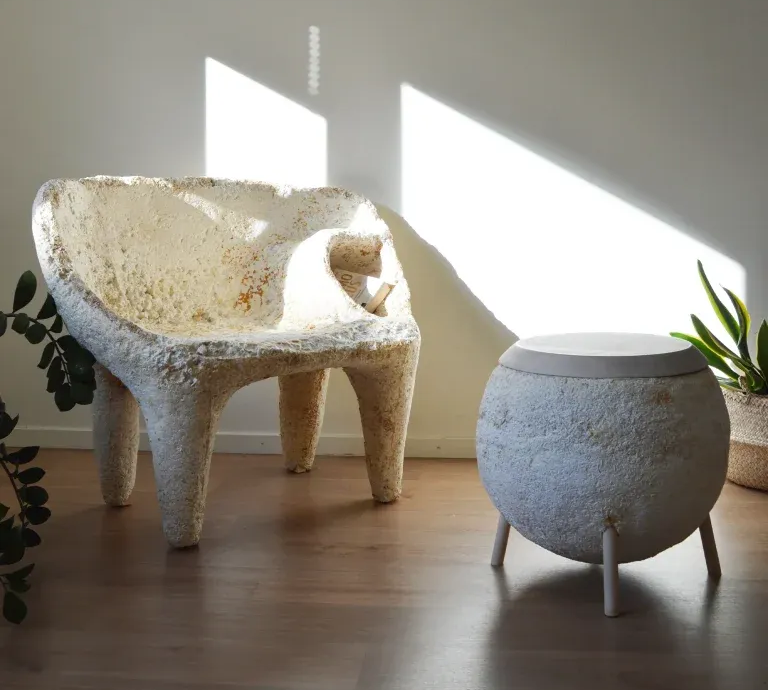
Mycelium is the root network of fungi, and it could become a sustainable alternative to plastic. Producing mycelium involves a six-step process that takes around 5–14 days. The process cultivates fungal root networks on agricultural waste substrates and guides their growth into a more durable and malleable composite material. This production process requires no synthetic inputs and creates a biodegradable material that can be composted at the end of its life. Here is how the process works, step by step.
Step 1: The substrate is selected, which means selecting the organic material the mycelium will feed on and bind onto. (substrates examples: corn stalks, sawdust, recycled paper, etc.)
Step 2: Before inoculation, the substrate is cleaned with heat (either pasteurisation or sterilization) before being cooled and adjusted to the correct moisture level; 50-60 percent water by weight.
Step 3: Inoculation, the substrate is introduced to fungal spores or grain spawn. Grain spawn produces faster, more reliable colonisation than spores alone, which is why its used for more commercial settings. The inoculated substrate is then put into the mold that it will take shape into.
Step 4: The molds are taken into a controlled environment so that it can incubate.
Step 5: Once the mycelium has taken the shape of the mold, it is deactivated by heat treating it, if this step isn't done, the mycelium would eventually start to grow mushrooms.
Step 6: Drying and Finishing. The material is dried to the density needed for the specific design.
But how does mycelium production compare to conventional manufacturing?
The differences between mycelium production and conventional material manufacturing go beyond the obvious swap of “natural” for “synthetic.” The underlying production logic is fundamentally different.
The trade-off is that mycelium composites currently can’t match polystyrene or aluminium on production speed or mechanical consistency at scale – a known challenge for designers and manufacturers working with the material. But for applications where end-of-life impact and material sourcing are priorities, the comparison shifts considerably.
Mycelium’s environmental profile has a strong argument for being more commonly used. Mycelium can be composted at the end of its life, it requires a humid environment but uses less water than other resource-farming techologies, and it only requires organic matter to work.
One area worth watching: the energy used in sterilisation and deactivation. While far lower than metal or plastic production, it’s not zero – and as the industry scales, optimising these stages will be important to maintain mycelium’s environmental advantage.
I like the idea of a technology that allows us to create furniture and products from a controlled, mushroom-like material. Mycelium feels especially innovative because it can be composted at the end of its life, unlike plastic, which requires specific recycling processes to be reused. I also like that it uses agricultural waste and does not require synthetic inputs. However, I am interested in how customizable this material can become. If designers begin adding coatings, adhesives, or other materials, it could make the product harder to compost and reduce its environmental benefits. I think this is an important reminder that designers need to consider the entire life of a product, not just the material it starts with.
Reference
AboutFutures. (2026, May 6). Mycelium Production Process Step-by-step Guide. https://aboutfutures.co/mycelium-production-process/



