
Numbers
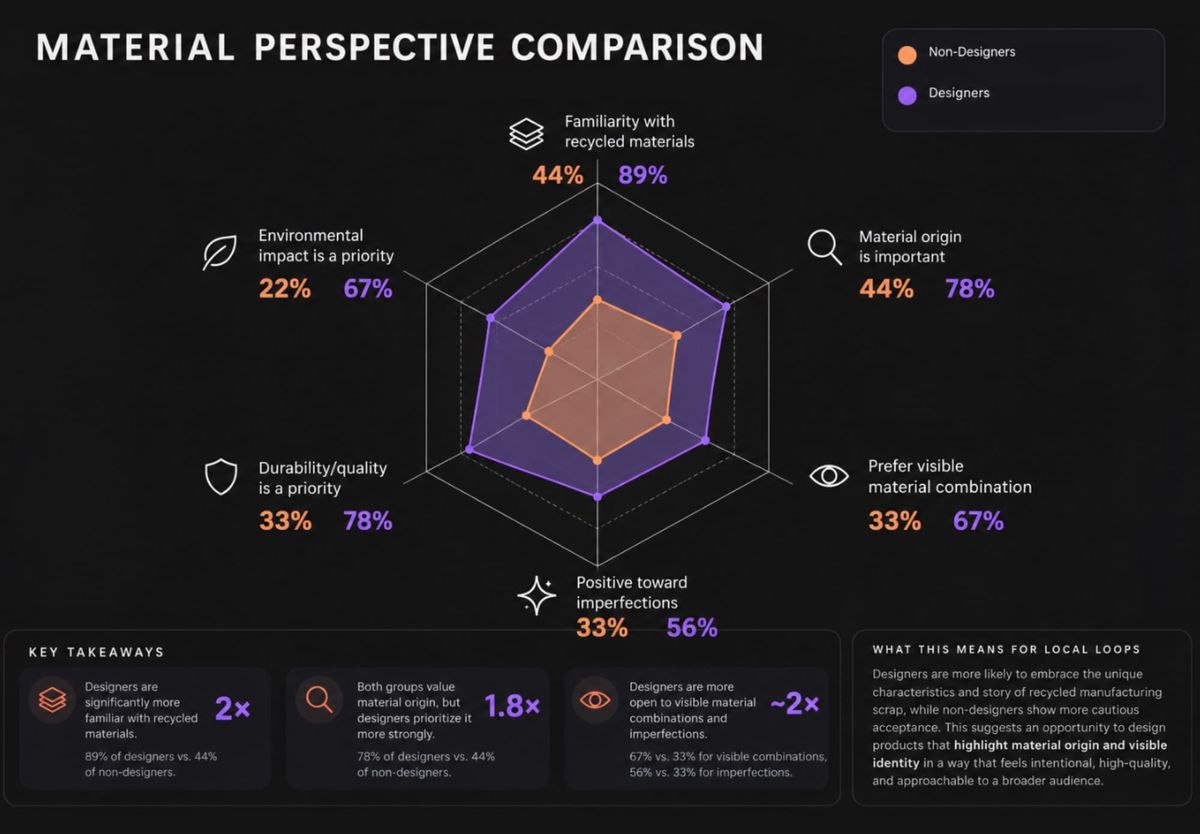
The purpose of my survey design was to understand how two groups of people perceived manufacturing scrap and recycled materials, with the goal of identifying opportunities for the Local Loops projects. The two groups that I decided to recruit for the surveys were participants with designer backgrounds and non-designer backgrounds. The designer group that I decided to survey was from an architecture studio in Cleveland, Ohio, with around 40 employees, from which I received 17 replies. The non-designer group was from a factory in Northeast Ohio with around 2o employees, of which 9 people replied.
This allowed me to compare how the material knowledge and design experience may influence the responses and identify areas where the problem space could be addressed. Rather than just presenting every question by itself, I grouped some of the responses that shared a similar theme into the visualization graphic above. The orange represents the non-designers that were sent the survey, and the purple represents designers. The graphic above allows for the differences between the two groups to be averaged out and displayed against one another. The visualization of the data suggests that designers generally showed a stronger familiarity with the material; however, both groups seemed to have concerns around the quality and material origin. The findings from the survey suggest that the recycled characteristics should be very intentional and easy to understand rather than just being presented as scrap waste.
Survey Questions:
1
How familiar are you with reclaimed and recycled materials?
Not familiar at all → Extremely familiar
2
When you hear the phrase “manufacturing scrap,” how does it make you feel?
Open response
3
How important is it for you to know where a material comes from?
1 — Not important → 5 — Extremely important
4
Would you prefer a recycled material to visibly show its material combination or appear more uniform?
Combination / Uniform
5
What types of products do you think are appropriate to be made from recycled materials?
Open response
6
Which factor is most important to you when purchasing a product made from recycled materials?
Open response
7
What materials do you think you come into contact with when interacting with products?
Open response
8
What would make you hesitant to purchase a product made from manufacturing scrap?
Select all that apply:
Durability · Appearance · Cleanliness · Safety · Material inconsistency · Higher price · Limited availability · Lack of information · Perceived lower quality · Nothing · Other
9
How would you react to small imperfections in a product made from manufacturing scrap?
Very negatively → Very positively
10
What would make you personally want to keep a product made from manufacturing scrap rather than throw it away?
Open response
Reference:
Figure 1. Material Perspective Comparison. Data collected and analyzed by the author through primary survey research with designer and non-designer participants. Visualization created by the author with assistance from OpenAI ChatGPT, 2026.



