
One Man's CNC Milling Scrap is Another Man's Bench
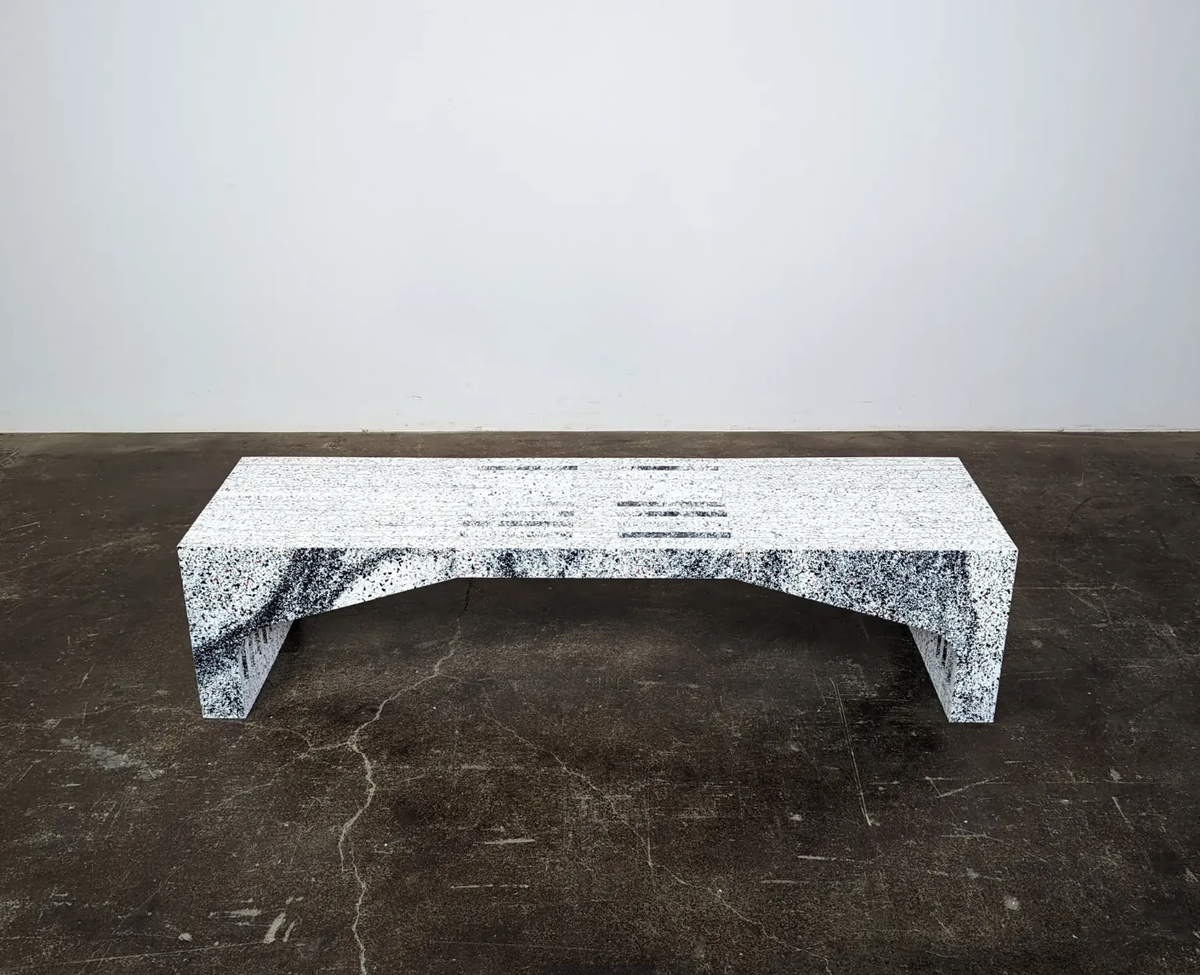
It is undeniable that waste is always going to be generated when products are being made; how we treat that waste is the important part. For this problem space, we have partnered with local business Marble Plastics. They are a Columbus manufacturer of 100% recycled solid surface sheet for commercial interiors. They take plastic waste and press it into dense, rigid 4×8 sheets that architects and designers specify for countertops, wall panels, furniture, and retail fixtures. The problem space that they have us exploring is not so much how we can recycle the waste, but rather how we can create value from the waste.
Before starting to look at potential solutions, we first had to gain a better understanding of the problem space. One of the first steps in investigating the problem was taking a visit to Marble Plastics. To better understand the problem space, we had to understand the process that Marble Plastics went through to create the waste and the process they used to collect, sort, clean, and produce sheets from the CNC waste.
While at first the problem space presented to our team only seemed like it was an interior issue for Marble Plastics, the more the situation was investigated, the more it became clear that it was not only a problem for Marble Plastics. There are many different systems and people that are connected to the material and influence the process. There is an obvious connection that Marble Plastics has to the waste material that is created through their manufacturing process. Since there are so many different people who interact with the materials, the view of the material varies widely. The workers who operate the machines interact with it differently than designers do. While the workers may see a material that is useless for one part of the manufacturing process, a designer might see a different manufacturing process for it. Next, we have to consider the consumer and how they may view the material. A consumer might not really care where the material comes from or how expensive or difficult it was to process the material. While this is just one part of a larger recycling and waste system, it provides useful insights into understanding the problem space better. What we see is that while the material itself is not changing, the value changes depending on who is looking at it.
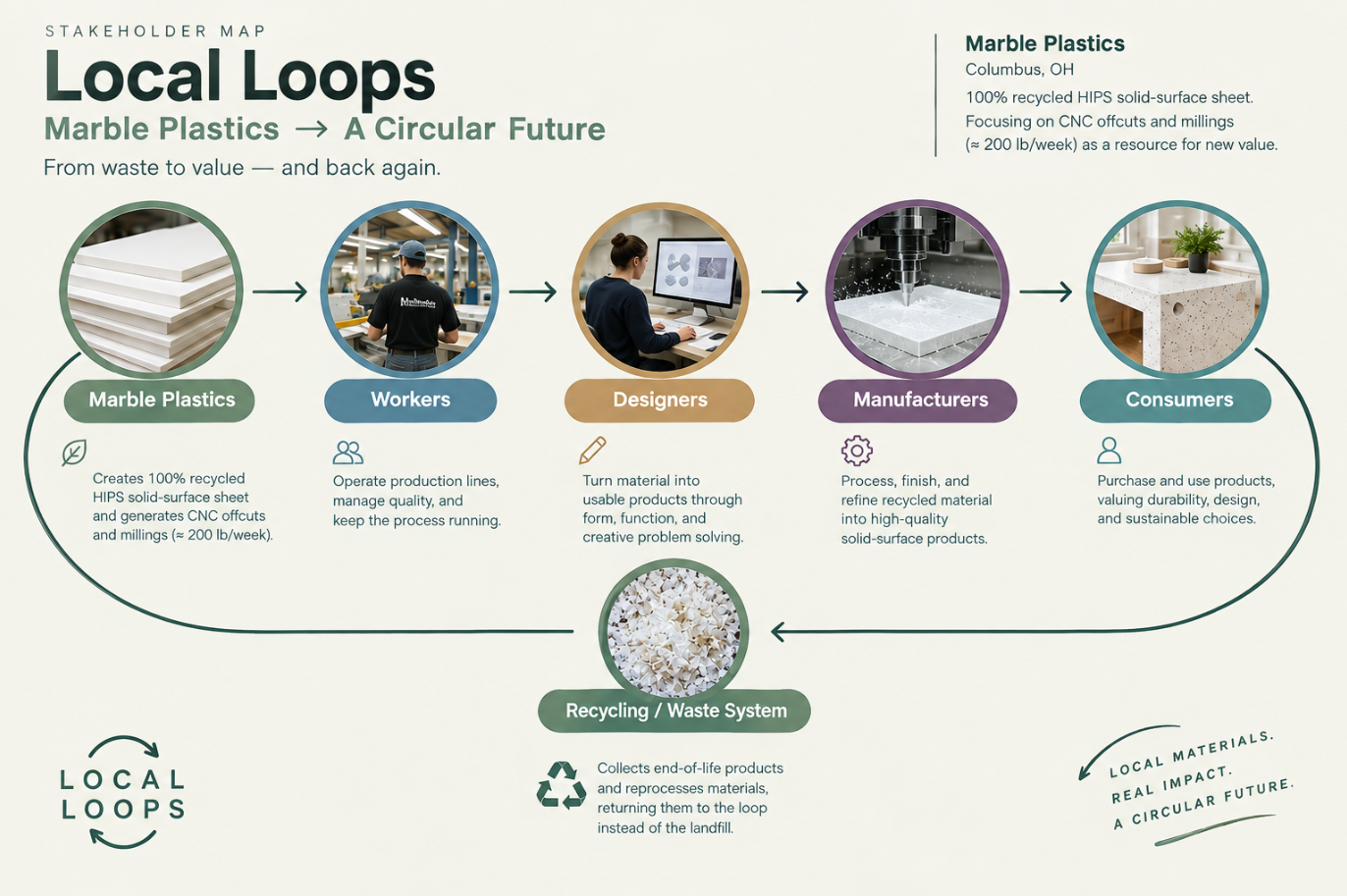
While looking into the problem space, it is useful to map out the systems that are interlocked with the problematic, rather than just identifying the symptoms of the problem. Waste does not just exist by itself; it is created from one process, moved somewhere else, and turned into something new.
Could waste actually be valuable? This is the premise of the problem space that we were presented with from Marble Plastics. In the article Modern Materials: Plastics, they state, “Although developed in the mid-nineteenth century for commercial purposes, it is the twentieth-century artist who has adopted plastics as an art material. Plastics in all forms are being developed and will continue to find their way into works of art in unique and varied methods” (Mustalish, 2004). It explains how plastic went from a new material to completely taking over every industry, since the material had the ability to be shaped and changed, making it useful for various purposes. The ideas presented in the article got me to shift the way I was thinking about the CNC waste from “What can be done with the scrap material?” to “What characteristics does the scrap already have that could be useful?” This type of thinking is shown in the article, Re-Purposing Materials: From Post-Industrial Recyclate to Accessible Furniture, by Enrique Tovar. In the article, it looks at HEWI’s Re-seat furniture, which uses recycled materials from the company’s own manufacturing process and suppliers. The article asks how manufacturing waste can be given a second life while creating something functional and desirable. For our Local Loops team, it is important to realize that the waste doesn’t necessarily need to be separated from the design; it can actually be part of the design and story. This ties into the design conjecture for the arts and lifestyle category of my research. The design conjecture asks: what if the millings were not treated as waste but intentionally incorporated into the products, where the variation of the material becomes part of the design. A lot of recycled materials are expected to look uniform and consistent; however, with Marble Plastics, they could offer something different. There is an opportunity to explore the story of the material through the design of the products. While the products can vary, they would all visibly communicate that they were made from material that was recycled from Marble Plastics' manufacturing process.
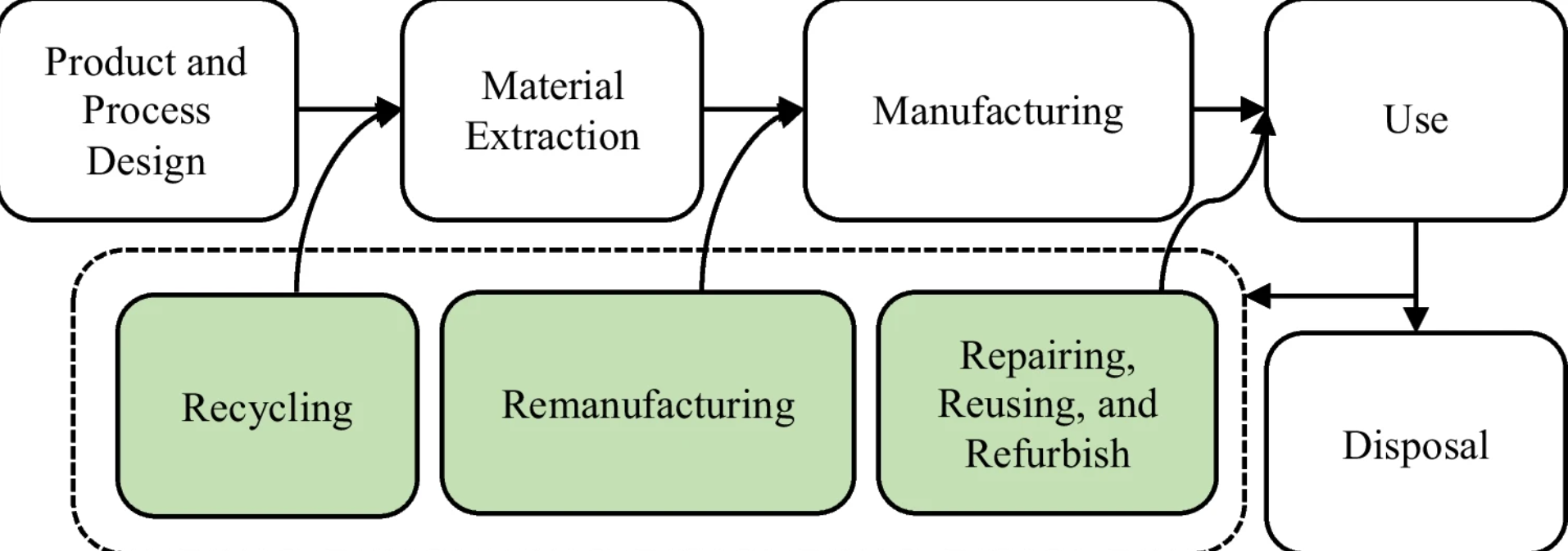
Recycling sounds simple until you think about all the moving parts around it. It is easy to say that Marble Plastics should just recycle and reuse all of the waste that it creates. However, this is not the case. Recycling requires a system built around it to create a sustainable practice. The system for recycling requires someone to collect the material, sort it, process it, and transport it to someone who wants to use it. An example of a circular business model that has been applied within similar industries is discussed in Matchmaking companies to turn waste into profit: Cape Town, by the Ellen MacArthur Foundation that “The Western Cape Industrial Symbiosis Programme (WISP) in Cape Town is Africa’s first industrial symbiosis programme. WISP connects companies, helping them identify opportunities to exchange unused or residual resources from one company’s manufacturing processes to become raw materials for another” (Ellen MacArthur Foundation, 2021). The program that is being run in South Africa shows that it is possible for businesses to exchange materials that would otherwise be discarded. There is a catch with this process. The circular system only works if the material is worth moving through the cycle. The problem is not solely about creating the system for the material but about figuring out what makes the system worth participating in.
While a lot of the research conducted in this area was focused on the business side of the problem space, the science and technology research added additional layers to the issue. The material that Marble Plastics works with is HIPS, or high-impact polystyrene. While this material can be reprocessed multiple times, it does have an effect on the properties of the material that have to be heavily considered when addressing potential solutions for the problem space. Through constant reprocessing, the material becomes slightly more rigid and fragile. This is an important consideration to keep in mind because it means that we are unable to continuously keep recycling it forever without consequences. This also means that, for Marble Plastics, we have to be mindful of what the next use of the CNC waste will be. The waste needs to make sense for the actual properties of the recycled material.
It is easy to think that if a product is made from recycled materials, the consumer will automatically find value in it; however, this is unfortunately not the case. This is the point in my research where my special interest in consumer psychology became very relevant. In an article by Jodie Shaw titled, Why “Limited Edition” Works Every Time, she states, “Knowing all this doesn’t stop us. Rationally, we understand many “limited editions” aren’t truly rare. Emotionally, we don’t want to be the one who missed out. Scarcity makes products into stories. It creates a cultural timestamp. Buying the Pumpkin Spice Latte in September, or snagging a sneaker drop, isn’t about utility. It’s about belonging to the moment. We want what we cannot have. But scarcity also transforms consumption into participation. You’re not just buying a soda or a sandwich. You’re buying a place in the conversation” (Shaw, 2025). The idea that scarcity can change how consumers perceive the value of a product is interesting to consider in relation to Marble Plastics. This can shift the perception of the material, making the limitation of the material a part of the product's story. Diving further into this idea of scarcity and the idea of limited-edition products leads into the core idea of the design conjecture for my special interest: Creating artificial value through the use of limited-time runs where, instead of making each product identical, we lean into the material properties of the CNC scrap.
After looking at the material, the people involved, and the research around recycling it is clear that the problem is not about simply finding a use for the Marble Plastic waste. The problem is that the uniqueness of the material is treated as a problem when it should be treated as a source of value. Rather than trying to make each piece of scrap look the same, what if the difference between them was the reason consumers wanted them? The limited amount of material produced from the waste could be useful for creating these small-batch limited drops, with each product being slightly different and celebrating the story of where it came from. The visible variation in the material gives each piece its own unique identity, while scarcity creates a feeling of exclusiveness. This shifts the problem from "what can we make from the waste?" to "How can the uniqueness of the material create value?" I see an opportunity space that explores a system of locally made products that celebrate the identity and story of the material.
References:
Figure 1. Material Perspective Comparison. Data collected and analyzed by the author through primary survey research with designer and non-designer participants. Visualization created by the author with assistance from OpenAI ChatGPT, 2026.
Ellen MacArthur Foundation. (2021). Matchmaking companies to turn waste into profit: Cape Town. https://www.ellenmacarthurfoundation.org/circular-examples/matchmaking-companies-to-turn-waste-into-profit-cape-town
Jayawardane, H., Davies, I. J., Gamage, J. R., John, M., & Biswas, W. K. (2023). Additive manufacturing of recycled plastics: A ‘techno-eco-efficiency’ assessment. The International Journal of Advanced Manufacturing Technology, 126(3–4), 1471–1496. https://doi.org/10.1007/s00170-023-11169-8
Marble Plastics. (n.d.). Marble Plastics. https://marbleplastics.com/
Mustalish, R. A. (2004). Modern materials: Plastics. The Metropolitan Museum of Art. https://www.metmuseum.org/essays/modern-materials-plastics
Norton, M. I., Mochon, D., & Ariely, D. (2012). The IKEA effect: When labor leads to love. Journal of Consumer Psychology, 22(3), 453–460. https://www.hbs.edu/ris/Publication%20Files/11-091.pdf
Organisation for Economic Co-operation and Development. (2019). Business models for the circular economy: Opportunities and challenges for policy. OECD Publishing. https://www.oecd.org/en/publications/business-models-for-the-circular-economy_g2g9dd62-en.html
Shaw, J. (2025). Why “limited edition” works every time. Medium. https://medium.com/@jodiemshaw/why-limited-edition-works-every-time-bc6b06e964af
Tovar, E. (2023). Re-purposing materials: From post-industrial recyclate to accessible furniture. ArchDaily. https://www.archdaily.com/1007326/re-purposing-materials-from-post-industrial-recyclate-to-accessible-furniture



