
OP-ED: Reframing The Time And Space Families Already Share In The Car
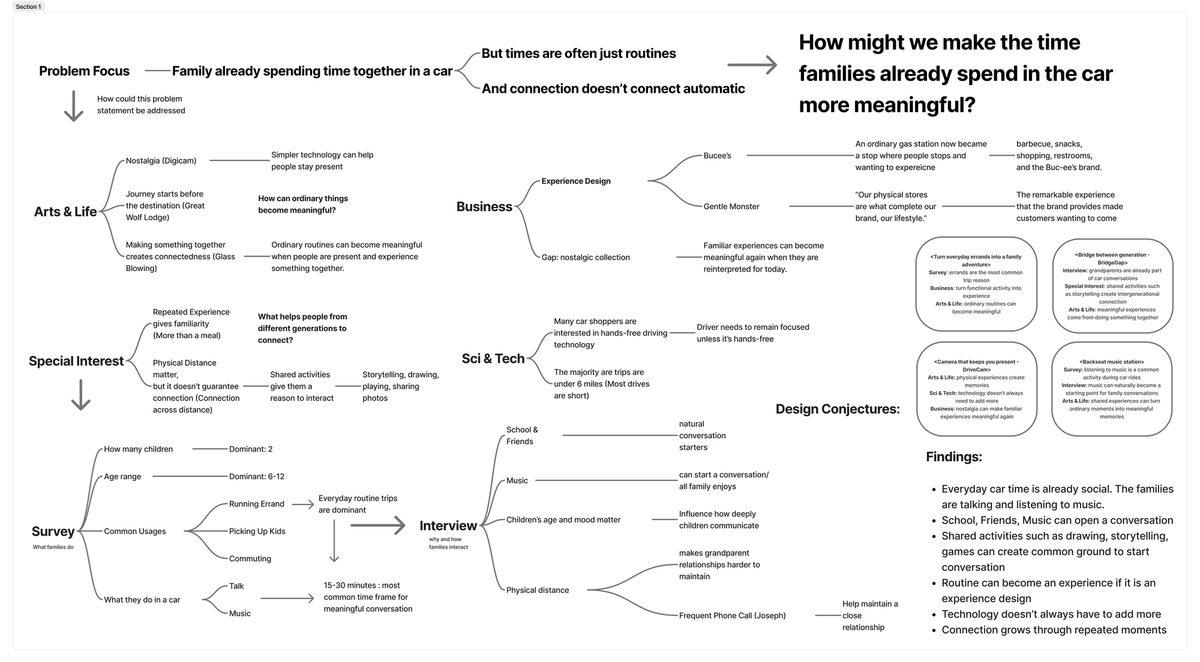
I started this project thinking about the car mostly as a space that takes families from one place to another. A child gets picked up from school, a family stops for groceries, parents drive to work, or everyone heads home. These trips are usually part of a routine, which makes them easy to overlook. But the more I looked at how families actually spend time in the car, the more I began to see the car as something more than transportation. It is one of the places where families already spend time together, even when that time is not intentionally planned as family time.
This made me question whether families really need more time together, or whether there is an opportunity to make better use of the time they already have. My research focused on this question: How might we make the time families already spend in the car more meaningful?

The car is already part of family life
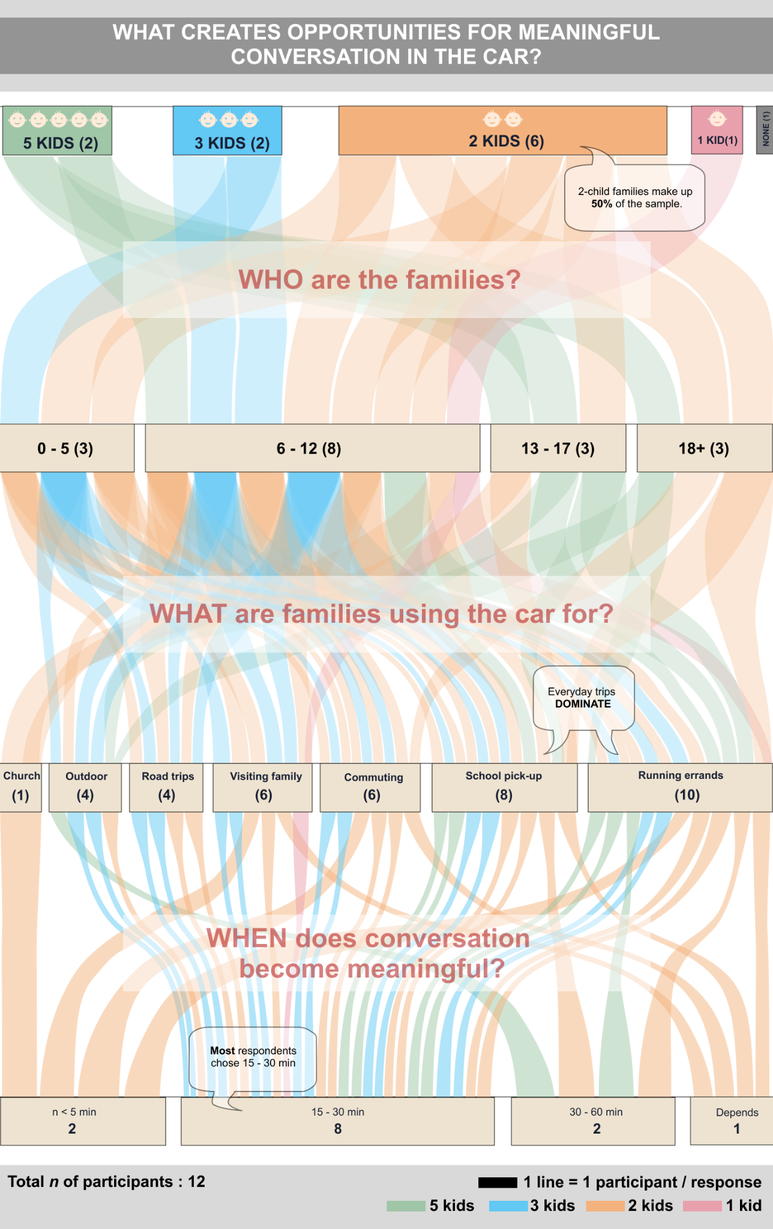
I started by looking at how families use their cars through a survey of the KCC Korean School community. 12 among 67 people participated, representing different family structures and ages. The survey was structured to ask who was in the family, what brought them into the car, how they spent that time together, and when the ride became meaningful, etc.
The results showed that many family car trips come from ordinary routines. Running errands was the most common reason for traveling together. Then commuting and school pickup were next. These activities happen repeatedly throughout the week.
At the same time, the car was already being used for social activities. Participants commonly talked, listened to music, podcasts, or audiobooks, looked out the window, and sometimes played games. When asked how long it takes to have a meaningful conversation in the car, 15–30 minutes was the most common response. This made me think about how much time families actually have during everyday trips. According to the U.S. Department of Energy, more than half of U.S. vehicle trips are less than six miles. Productivity Gladiator also uses 10 minutes of travel each way when estimating the time spent on a typical grocery trip. Together, these examples made me look more closely at the short, repeated trips families make every day and what could happen during that time.
Being together is not the same as connecting
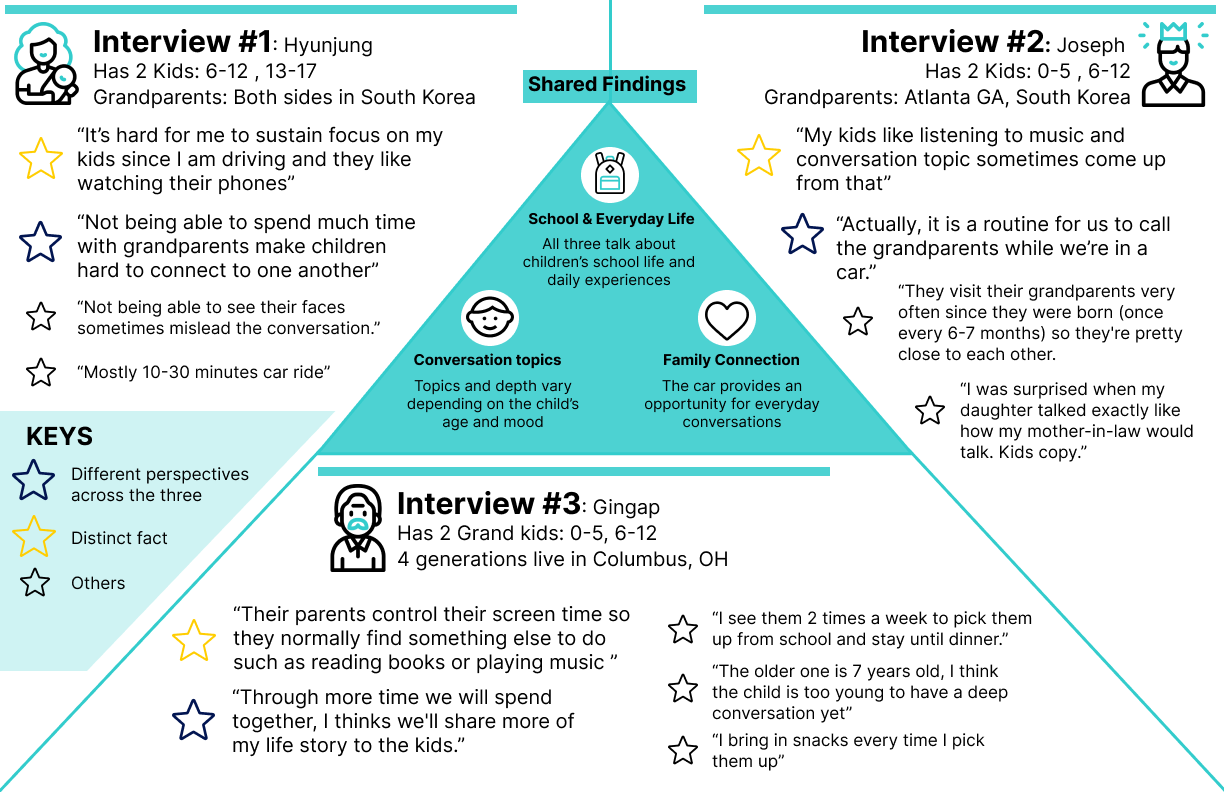
The survey showed me what families do in the car, but I wanted to understand what those interactions actually looked like. For my interviews, I selected three people from the KCC Korean School community whose relationships with grandparents were shaped by different levels of proximity. One family had grandparents living in South Korea, another family regularly called grandparents in Atlanta and South Korea, and another grandfather saw his grandchildren twice a week in Columbus.
I expected physical distance to be one of the biggest differences between the families. Instead, I found that age, attention, familiarity, and the type of activity happening in the car also affected how people connected.
Across the three interviews, school and everyday life were common starting points for conversation. Children talked about school, friends, what they had learned, or what was happening in their daily lives. However, these conversations did not always become deep or meaningful. Hyunjung explained that when her children are in the car, their attention can be affected by phones and other distractions. She also described the difficulty of building relationships with grandparents who live far away:
“Not being able to spend much time with grandparents make children hard to connect to one another.”
Joseph's family had a different experience. His children have grandparents in both Atlanta and South Korea. Calling them from the car has become part of their routine:
“Actually, it is a routine for us to call the grandparents while we're in a car.”
Music also became part of their conversations. He explained:
“My kids like listening to music and conversation topic sometimes come up from that.”
For Jingap, distance was not the main issue. He sees his grandchildren twice a week when he picks them up from school and stays with them until dinner. Their conversations are still simple because of their age, but he sees the repeated time together as something that can eventually lead to deeper conversations:
“Through more time we will spend together, I think we'll share more of my life story to the kids.”
These interviews made the situation more complicated. The car creates an opportunity for people to be together, but being together does not automatically create connection. Sometimes children are distracted. Sometimes grandparents are too far away. Sometimes the children are simply too young for a deeper conversation. But the repeated nature of these moments gives families something to work with.
Shared activity can give people a reason to interact
My Special Interest research on grandparents and grandchildren changed how I thought about connection. Shared activities can create a common context for interaction. Instead of expecting a conversation to happen on its own, an activity gives people something to respond to, talk about, and remember together.
The routine could become participatory
Running errands was the most common car activity in my survey, so I started with something very ordinary. While adults run errands like grocery shopping, picking something up, or going to the post office, children often come along without having much of a role in the process.
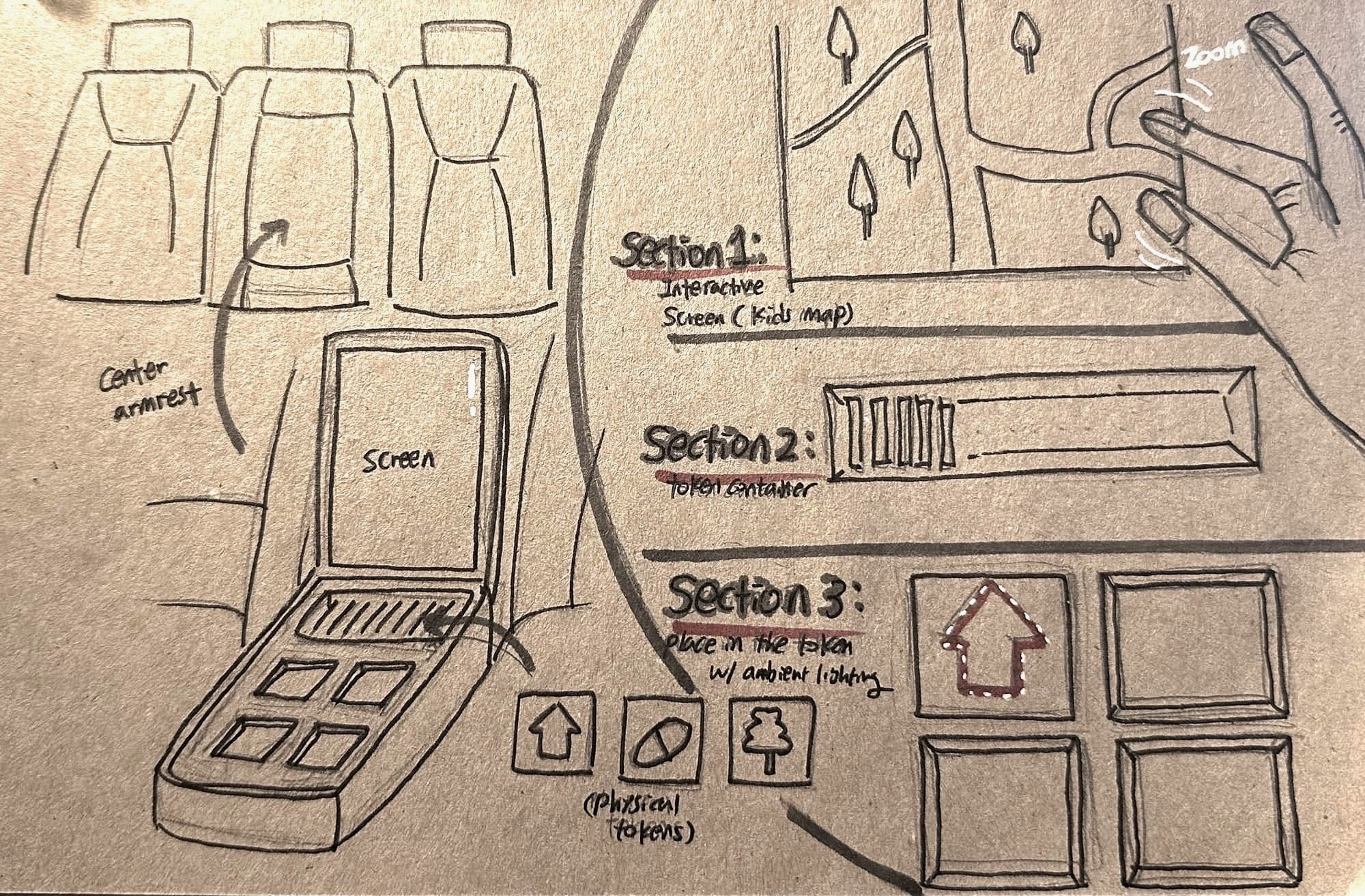
One concept that I came up with uses the existing backseat center armrest as a small planning station. Children could select physical tokens for different destinations and place them into the armrest. The car's digital map would then build the route as the tokens are added.
This idea connects with my Business research, where functional activities can become experiences particularly like how Buc-ee’s transformed the ordinary gas station into a destination experience, while Gentle Monster turned its flagship stores into places people intentionally visit. The goal is not to make an errand into a major event, but to give children a small way to participate in something the family is already doing.
A shared activity can bridge distance
My interviews showed that grandparents can be part of car conversations even though they are not physically together. Joseph's family regularly calls grandparents from the car, while Jingap sees his grandchildren twice a week. But distance, age, and attention can make these conversations difficult to sustain.
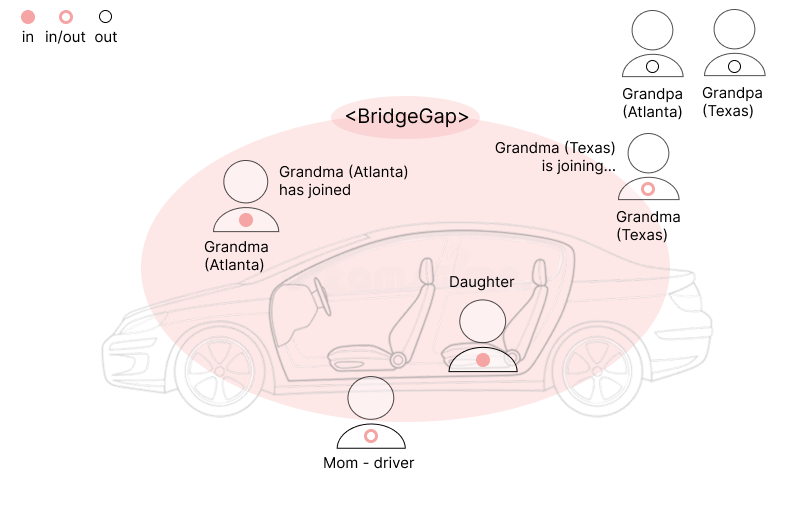
This led me to BridgeGap, a concept that uses the car's digital screen to create a shared activity between children and grandparents. Instead of simply adding another video call or drawing pad, the system introduces simple prompts that give them something to do together. A child might receive a prompt such as, “Draw something you saw today,” and the grandparent can guess what they are drawing. The activity creates a natural starting point for conversation without requiring either person to come up with a topic.
The drawing itself is not the main purpose. BridgeGap is about turning a repeated car ride into a shared routine that can gradually build connection between grandparents and grandchildren.
Music becomes the conversation
Music was another recurring part of my research. Survey participants commonly listened to music during car rides, and one interview showed how music could naturally become a starting point for conversation. This led me to think what if the music in the car was not just something families listened to, but something they made together?
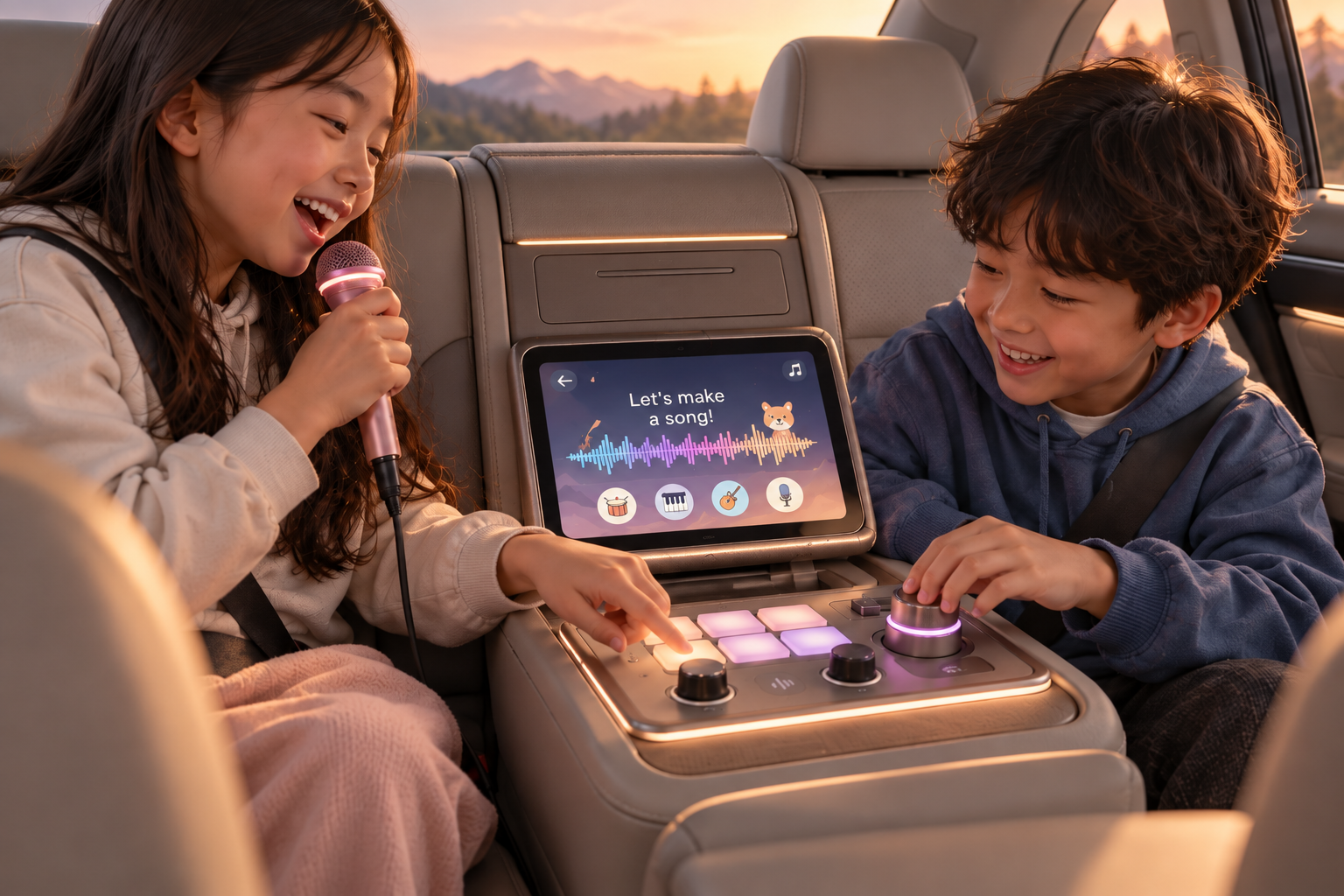
The Backseat Music Station explores what could happen if families created something from those conversations. Using the backseat center armrest as a small music-making station, children could talk about their day, choose a mood, build a beat, and turn their stories into a simple song. A funny moment at school, a story about a friend, or even a difficult day could become part of something the family creates together.
The goal is to give families a reason to talk, create, and listen to one another. Over time, the songs could become more than recordings. They could become reminders of where the family was, what they were talking about, and what they were experiencing together.
Reframing the time we already have
Looking across my research, I began to see the family car differently. Families are already talking, listening to music, running errands, picking children up from school, and sometimes calling grandparents. These moments may feel ordinary, but they happen repeatedly.
For my design opportunity, I have to reconsider what can happen within the time families already share. These design concepts explore different possibilities such as giving children a role in an everyday routine, giving grandparents and grandchildren something to do together, or turning conversation into music.
The car will always take us somewhere. But the time spent getting there does not have to be treated as empty space between destinations. It can be a place where families talk, create, participate, and remember. What happens between destinations may be just as important as where we are going.
References.
Bennett-Cohen, J. (2024, July 14). Why Digicams Are Becoming Popular (again). Medium.
Brian Nelson-Palmer, Get Groceries Delivered. You Running Errands? Or Are Errands Running You?, Productivity Gladiator.
Dowd, J. (2021, March 3). Experiential Retail Goes Surreal at Gentle Monster’s Latest U.S. Flagship. Retail TouchPoints.
McBride, Duane C.; Sedlacek, D.; Baltazar, A.; Matthews, L.; Chelbegean, Romulus; and Hopkins, Gary, "Family Bonding and Family Dinners" (2013). Faculty Publications. Paper 3. http://digitalcommons.andrews.edu/behavioral-pubs/3
Quora, What are some common errands people do weekly or monthly? Groceries, mail, driving to work, etc.
Van Cleave, K., & Earl, J. (2025, September 1). How Buc-ee’s became the gateway to the great American road trip. CBS News. CBS News — Original Article
Viguer, P., Meléndez, J. C., Valencia, S., Cantero, M. J., & Navarro, E. (2010). The Spanish Journal of Psychology, 13(2), 708–717.
Vutborg, R., Kjeldskov, J., Pedell, S., & Vetere, F. (2010). Family storytelling for grandparents and grandchildren living apart. In Proceedings of the 6th Nordic Conference on Human-Computer Interaction: Extending Boundaries (pp. 531–540). ACM. https://doi.org/10.1145/1868914.1868974
About 70% of the content is based on the author’s original research, analysis, design conjectures, and writing; About 30% reflects AI assistance in editing, refining language, organizing the author’s ideas, and improving clarity and flow. All interpretations and final decisions remain the responsibility of the author.



