
Op-Ed | Cars and Family: A Match Made Imperfect

Introduction
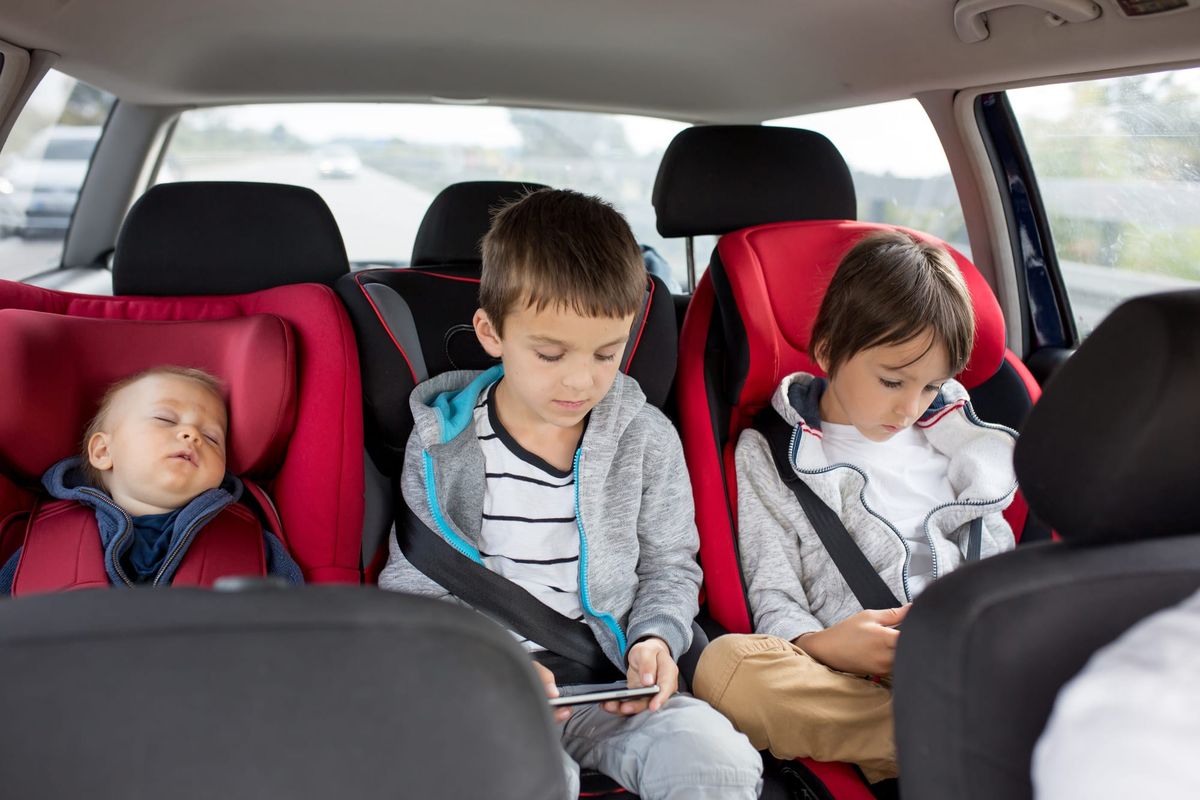
When you think about the role that the car plays in a family’s life, it might often be understated for its value. I would argue that cars can act as a third space that families share on almost a daily basis with the other spaces being school for children, work for parents, and of course the home for both. With that perspective on car’s use in a family, it then becomes a crucial place for interaction that can grow with its users and can build memories. Addressing the needs of families in the car is especially essential to ensuring the space can foster the physical, social, and mental capacities needed to help with healthy child development. However, growingly difficult barriers continue to cause problems with supporting an environment like this like parent’s and children’s excessive use of screen time, social media, and gaming that can negatively impact a child’s learning, cause things like an attention deficit, anxiety, and harm family dynamics. This is the problem that our team at Honda has tasked us to try and overcome and an issue that many designers are trying to bring focus to.
Background
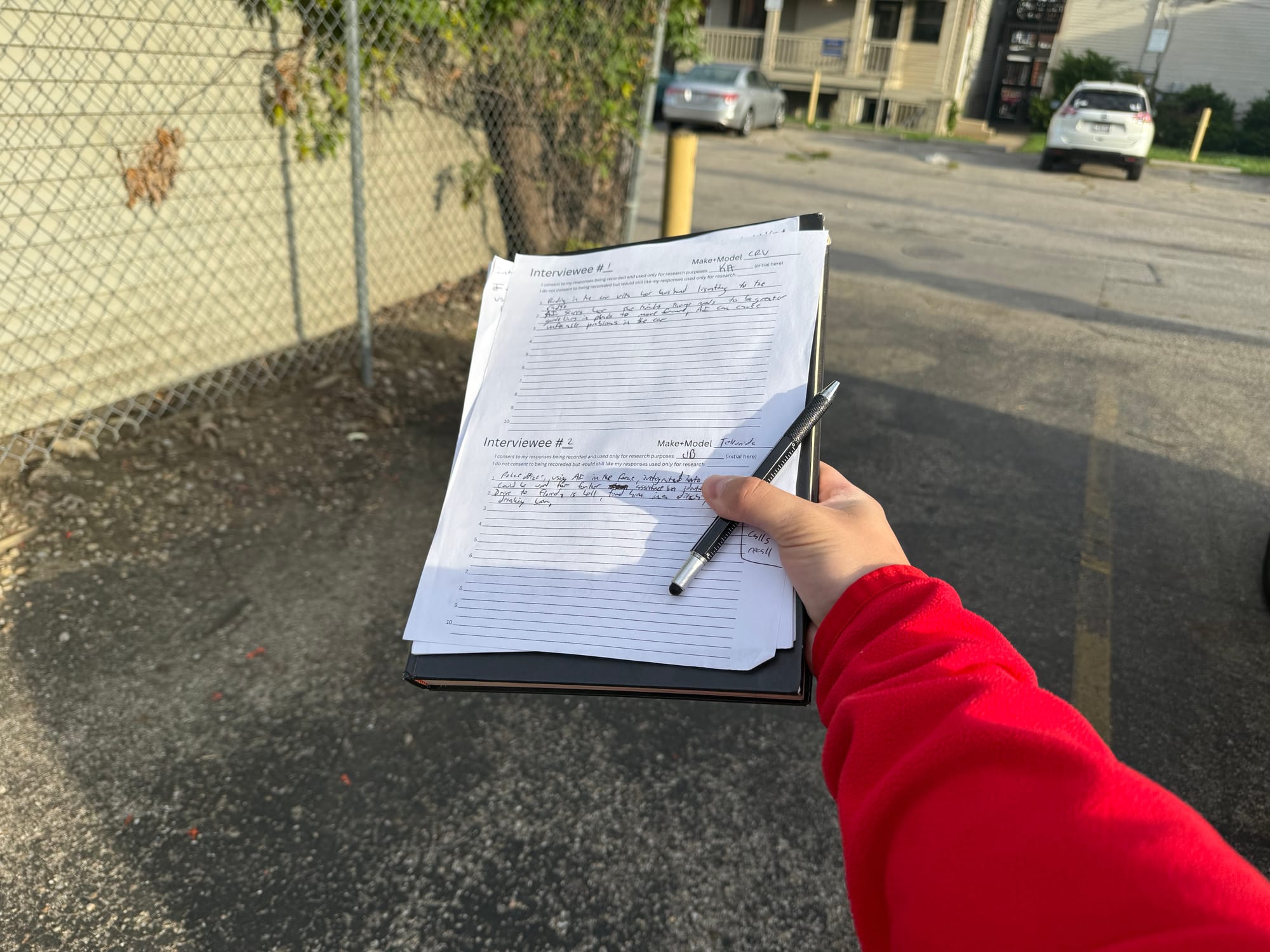
In my primary research (Figure 1), I talked to an assortment of parent and non parent car owners and when asked what their children or passengers most often do in the back seat, many of them responded saying that they are typically on their phones or using a personal device. A couple of them expressed how this was a very normal thing and some even said that entertainment like this was necessary for them because they are often driving by themselves with their children in the back.
From this, it started to become clear that the problem wasn't the presence of screens themselves in the car, but rather the content that is being consumed on them. So, the goal then becomes to provide content either with an entertainment system in the car or with an added service or product that can help put an end to or reduce the issues present in Honda’s problem statement above. Through my secondary research, I was then able to identify several possible methods of intervention that range from the audio,
Music
Music has always been an integral part to the car experience and remains as one of the main sources of entertainment for families while driving. I know for sure that some of my favorite memories of my family and I are of us listening to music my parents used to love when they were younger and sharing stories of how it came into their lives. These genres and artists continue to bond my parents and I to this day.
My case is not an isolated one as researchers from the University of Arizona surveyed young adults around the age of 21 about their relationship with their parents and how often they participated in music related activities and found that listening to music with little kids is very important in bringing them closer to their parents and even more serious with teenagers to make sure those bonds stay through adulthood (Blue, 2018). They also determined that actions like synchronization and empathy emitted during the listening experience strengthens the parent-child relationship (Blue, 2018). It’s impressive to know that such a powerful tool for engagement already exists in the car with the radio and has been used by families for generations.
Even with the car radio’s established reputation, I still feel like the actions mentioned in the study are limited in the car and there are many possible ways to cultivate a stronger music experience for all passengers. It could perhaps be found in an interaction where parents and/or children could participate in making music as demonstrated in the conjecture found in Figure 1.
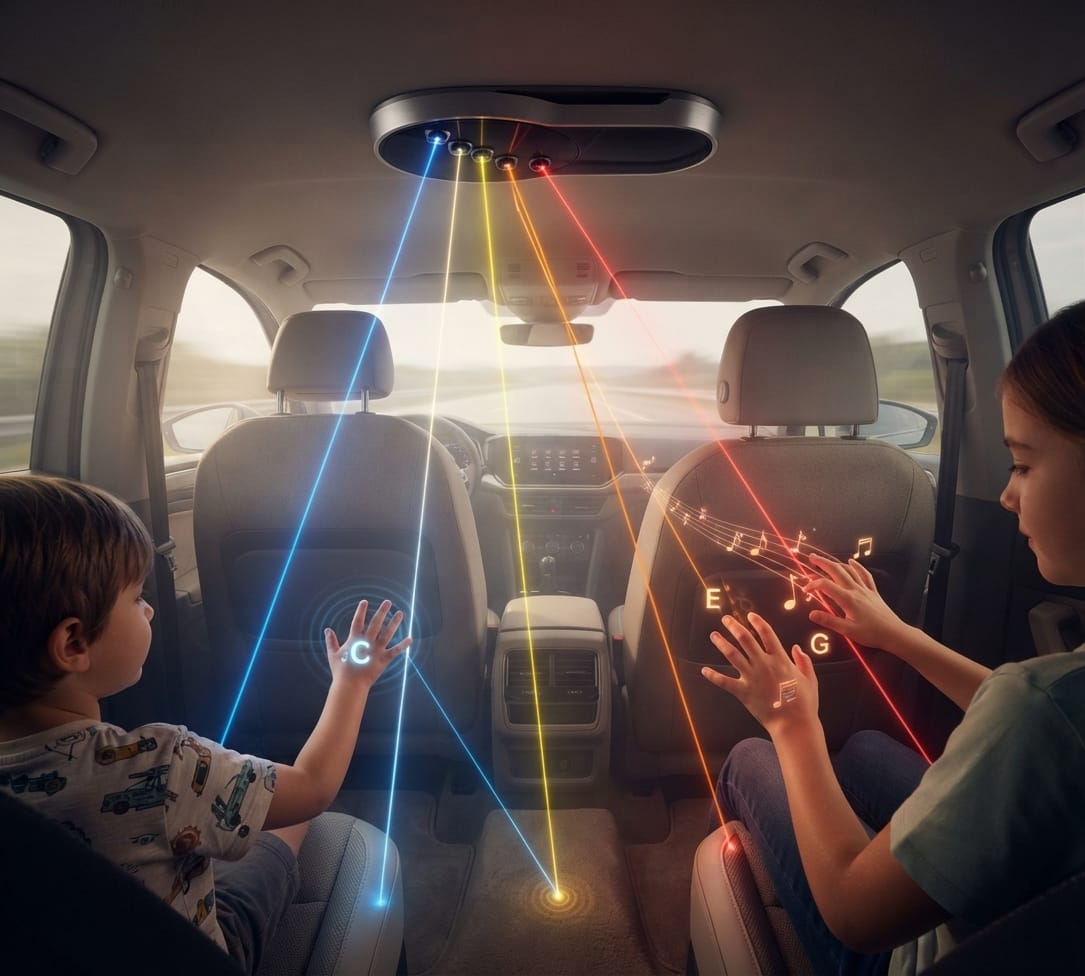
This concept, while flawed, highlights a possibility for moving one’s body to music and calls back to the idea of synchronization. Being able to create music in live time is an even more meaningful exposure especially with parents and children. An initiative called the Lullaby Project works towards these values as it encourages parents to make a lullaby for their infant child and in turn “supports maternal health and wellbeing, which in turn positively impacts child development” (Sindeli et al., 2022). This story highlights the love that all parents carry for their children and how that energy is being converted directly into music. The deep power that music has to change all of us is an important key to life in the car with family and can and should be leveraged to better the relationships of parents and children while driving.
Education
From short to long road trips there are many opportunities for children to be growing and learning. The foundational skills that children need are just as valuable to cultivate in a space like the car as much as anywhere else. The LiFEsports program at Ohio State seeks to develop these kinds of skills in children with their weekly sports events centered around “preparing youth for life and leadership” (OSU LiFEsports, n.d.). Their model for growth is able to reach all ages of children from toddler to young adults with its participation, volunteering, and leadership opportunities that grow with children.
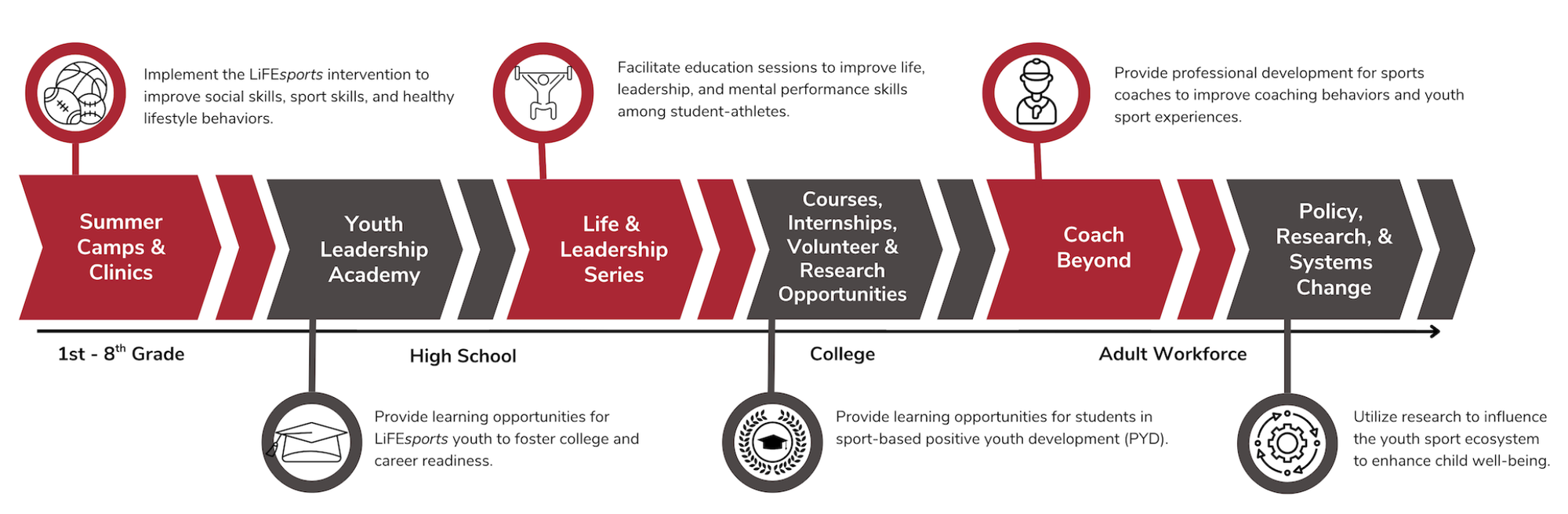
Their way of teaching life skills through the lens of sports is a very simple application that couldn’t necessarily translate to the car space but many other forms exist that could be used to integrate It’s also extremely relevant that if something like this is designed, it should be considered that an educational entertainment system in the car would be best to cater to a wide range of ages and topics and be able to grow with the children. The LiFEsports model and the way they encourage youth development is something, whether I go in this direction or not, I want to look more deeply into to get a better understanding of how it can be applied to the car.
The Mediator
With the rise of AI and assistive technology, there are a multitude of uses being imagined and executed to help parents, children, and drivers in general. Many devices already exist in our everyday lives that can assist us or bring us moments of clarity like Siri or Alexa, but many more robot forms have made their way into cars and the lives of families. For example, the Chinese electric car company, Nio, has created an in-car voice assistant called NOMI that they say “reflect[s] the soul and core of a car” and that it could “treat the car as if it were its own muscle the moment the owner opened the door” (Zhang, 2021).
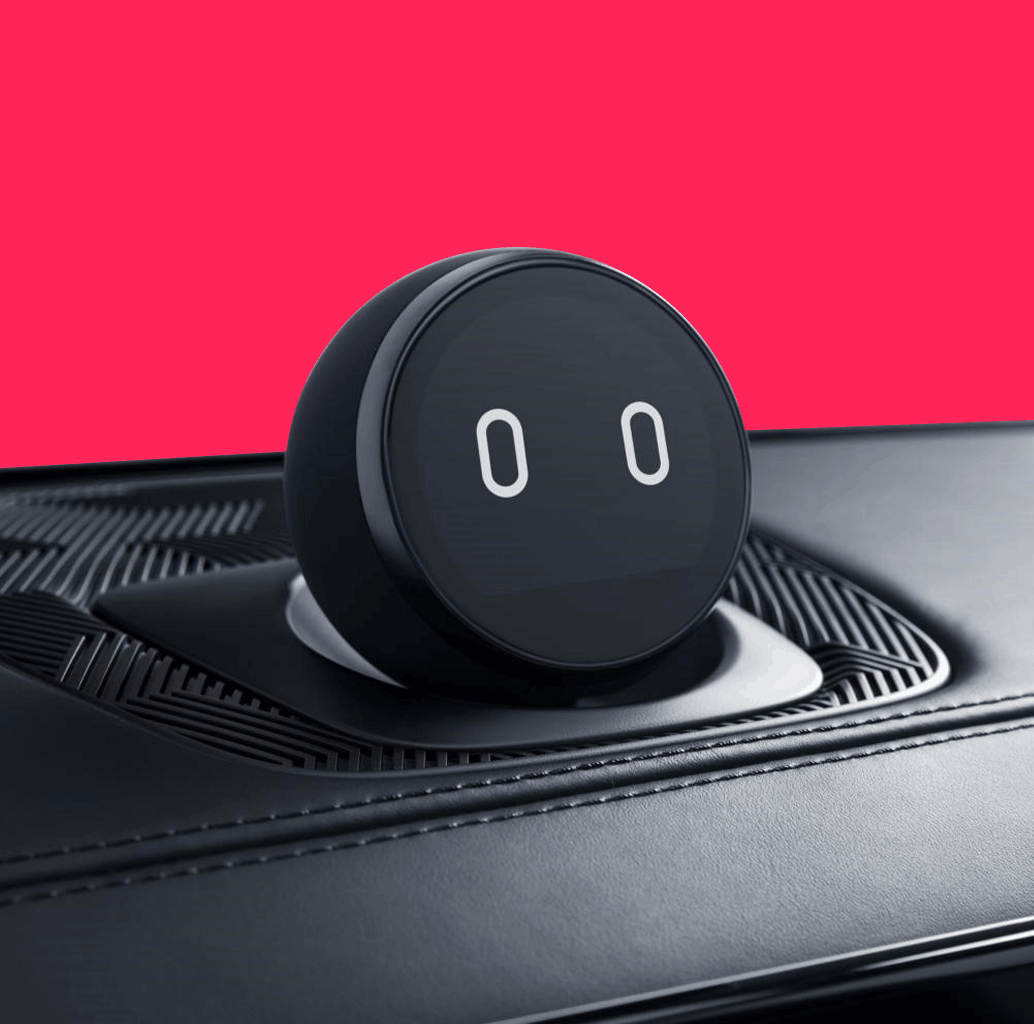
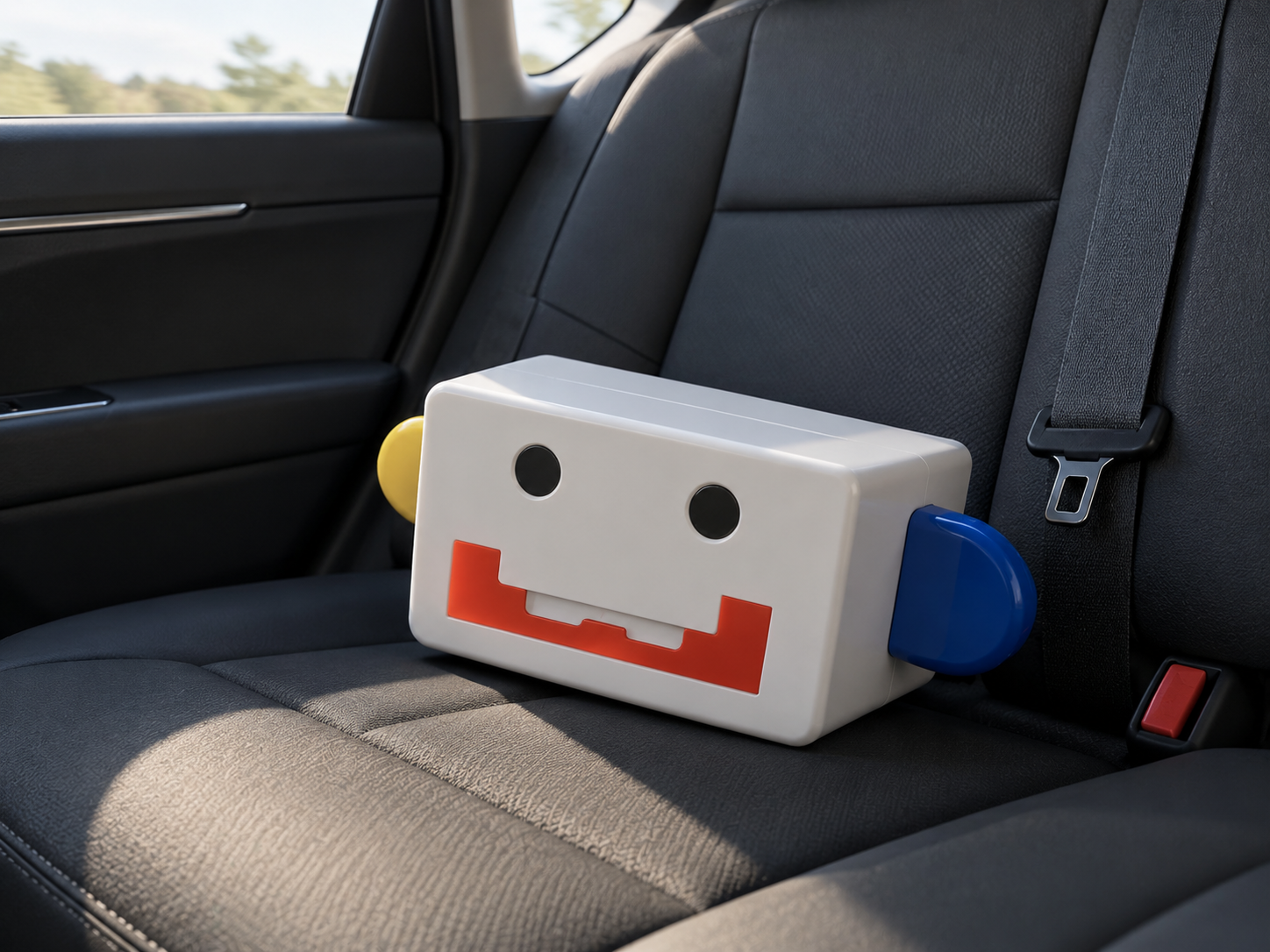
Photo of NOMI on the left ("Co-designing the worlds," n.d.) and backseat companion for child visualized using Gemini from original sketch on the right
It has an ability to adjust to the passengers of the car and, in real time, understand the needs of those in the car. NOMI, as a robot based in an artificial intelligence system, has great potential to help out with even the slightest issues that arise in the car and can help quell the animosity that comes with life in the car. A specialized experience like this in the car is just the beginning of how artificial intelligence can ease drivers and passengers as many in the automotive industry are looking at how it can benefit their car’s internal systems. Stellantis is diving head first into this technology and is creating an “intelligent in-vehicle infotainment” that “tailor[s] interface layouts, applications, navigation stacks [...] on a single, cost-efficient platform” (Stellantis and Applied Intuition, 2025). Artificial intelligence systems like these are now able to easily solve problems that were difficult or even impossible before. It’s especially important with improving the infotainment systems that often cause frustration for drivers and create tension for passengers. Families can benefit from the way systems like these can fill in the problem gaps of the car and can leave room for added conversation, listening experience, or just general relaxation.
Resolution and Direction
It’s now pretty clear that there are many opportunities for designers to improve the parent-child relationship in the car. Personally, I feel that some of the most important interactions between parents and children in the car are those that already exist like in the realm of music which is perfectly fine the way it is right now but I believe it could be leveraged to strengthen this connection even more. These kinds of experiences can be enhanced to bring more meaning to life in the car and the way families view their time in the car with their loved ones. Not to mention the many improvements that could be made with not only the first but also the second row infotainment systems to provide more useful information in a responsive way. Possibilities like this are becoming more relevant and achievable with the advent of artificial intelligence and its becoming increasingly useful in many parts of our lives. Ultimately, it’s possibilities like these that I will continue to study to exercise thoughtful design interventions in order to improve the way families connect in the car.
References
Blue, A. (2018, May 2). To Improve Relationship With Kids, Try Turning Up the Music. arizona.edu. https://news.arizona.edu/news/improve-relationship-kids-try-turning-music
Co-designing the world’s first in-car companion. star.global. (n.d.). https://star.global/cases/nio-nomi/
OSU LiFEsports. lifesports.osu.edu. (n.d.). https://lifesports.osu.edu/
Sindeli, A., Ella, H., Barron Viela, I., & Jay, L. (2022, June 22). The Lullaby Project: Music bonding mothers and babies. globalleadersinstitute.org. https://www.globalleadersinstitute.org/blog-post/the-lullaby-project-bonding-mothers-and-babies-through-the-transformative-power-of-music/
Stellantis and Applied Intuition Launch the Future of Cabin Intelligence. appliedintuition.com. (2025, October 21). https://www.appliedintuition.com/blog/applied-intuition-stellantis-partnership
Zhang, P. (2021, March 29). What is Nomi? here’s Everything you need to know. cnevpost.com. https://cnevpost.com/2021/03/30/what-is-nomi-heres-everything-you-need-to-know/



