
Perception of Safety In Relation to Street Lights
Special Interest
An experimental stud on light distribution in dynamic street lighting and its effects on perceived safety was published by the Eindhoven University of Technology in the Netherlands. The journal article published in 2012 by Antal Haans and Yvonne A.W. de Kort outlining two experiments done on a pedestrian street by manipulating the already installed lamp posts.
Sample
"Twenty-nine women participated in the experiment. The
participants’ mean age was 22.9"
The first experiment focused on women and how they feel safe in different lighting conditions. They also studied the factor of masculinity versus femininity among the participants. I am not taking the personality types into consideration as I move forward. I do wish they had done this portion of the experiment with men as well. However the data on the preferred lighting situation is valuable to me.
Experiment Set Up Strategy
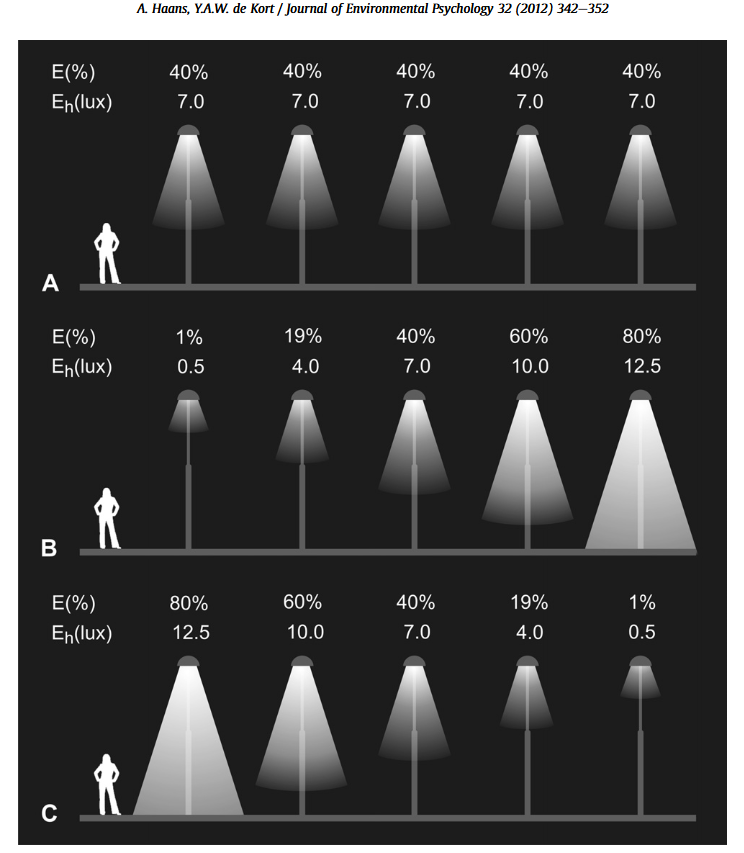
"By using a fixed total illumination budget, we assured that any differences in perceived safety ratings were not due to differences in overall illumination levels"
Before reading the full journal article I was skeptical if their data would be compromised due to the amount of total light. I was relieved to read this and see the visual to better understand the set up.
Pairwise Comparison
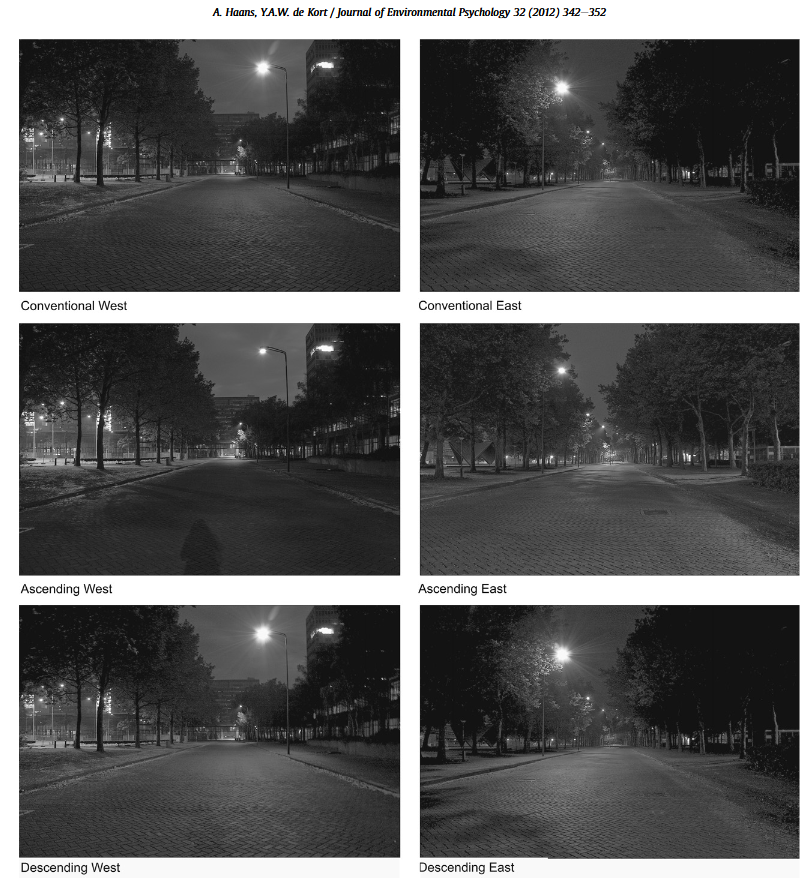
In groups (maximum of 4) participants stood in the middle of a pedestrian walkway and looked down the street to rate how safe they felt.
Results
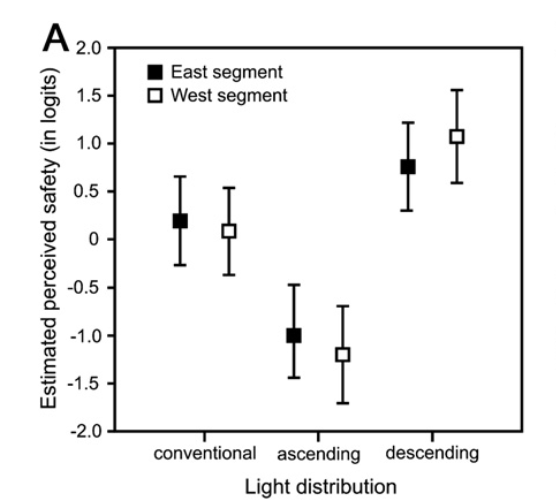
The study found that the east versus west segment of lights did not make a statistically significant difference however there was a preference for the descending light distribution scenario C as pictured in the Experiment Setup Strategy section.
Limitations of Experiment
They only had control over 5 lamp posts on the street so other lights further in the distance could potentially be a confounding variable.
Relevance to ODNR
This experiment gives insight into how light makes us feel safe at night. The first reason that comes to mind as too why people may not want to change their lighting practices is the idea that more light makes a space safer.
If there is a way to lessen the amount of light pollution while also preserving the feeling of security in a space that could be what is needed.
It's also necessary to consider that this study had a small sample excluding male opinion and it was done in the Netherlands which I would imagine is quite different from Ohio.
References
Bolliger, J., Haller, J., Wermelinger, B., Blum, S., & Obrist, M. K. (2022). Contrasting impacts of street light shapes and LED color temperatures on nocturnal insects and bats. Basic and Applied Ecology, 64. https://doi.org/10.1016/j.baae.2022.07.002



