
Post-Consumer HIPS
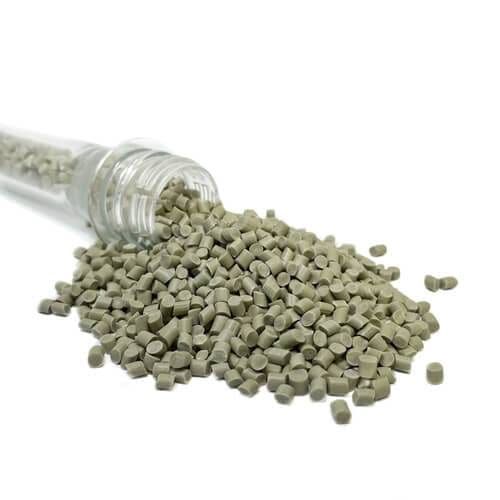
This study consisted of an investigation of the thermo-mechanical properties of post-consumer high impact polystyrene (HIPS) through five consecutive injection moulding steps to simulating the recycling cycles. The selectively collected HIPS residue was ground, washed only in water, dried, agglutinated and then moulded as a set of mechanical test specimens before the first step. The melt flow index (MFI), glass transition temperature (Tg), complex viscosity (η*), deflection temperature under flexural load (HDT), tensile, flexural and impact strength tests were determined at each reprocessing cycles. The results revealed that the degradative effect of consecutive recycling on the material's thermal properties was low and may be considered negligible.
After five reprocessing cycles, the results showed an ∼8°C decrease of Tg in DSC, an increase of MFI, a decrease in viscosity and a slight decrease of HDT, which could be attributed to chain scission caused by consecutive cycles of exposure to shear stresses and high temperature. The material became slightly more rigid and fragile, as indicated by the mechanical tests. (Santana & Manrich, 2002)
This article is very important to consider for the Local Loops project space because it tests what happens to HIPS when it is repeatedly processed. In the study that was done on post-consumer HIPS, they simulated the recycling by putting the material through five consecutive injection-molding cycles and then measuring the thermal and mechanical properties. The results of this experiment found that the degradative effect on the thermal properties was relatively low. It was also found that after multiple cycles through the process resulted in a material that was “slightly more rigid and fragile.” This is directly related to the Marble Plastics problem space because we have to consider what is happening to the material if it is subjected to multiple cycles of processing before it can be used again. Understanding the changes that the material goes through during reprocessing is key in determining what it can be used for and what problems it could address.
References:
Santana, R. C., & Manrich, S. (2002). Studies on thermo-mechanical properties of post-consumer high impact polystyrene in five reprocessing steps. Progress in Rubber, Plastics and Recycling Technology, 18(2), 99–110. https://doi.org/10.1177/147776060201800202



