
Public comfort with AI in healthcare falls, Ohio State survey finds

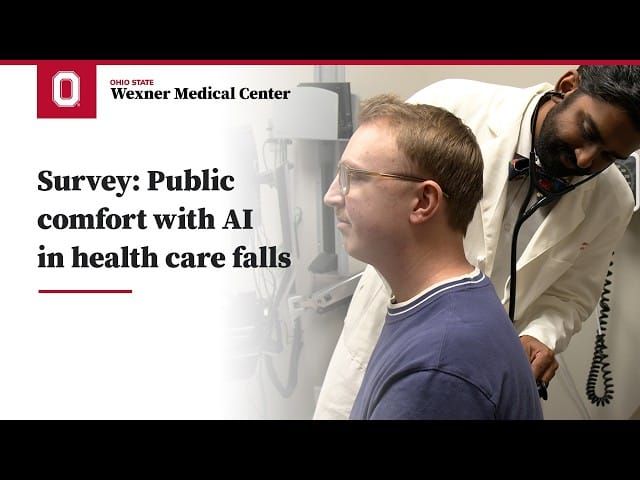
“The national poll of 1,007 adults found only 42% are open to AI being used as part of their care compared to 52% when this survey first ran in 2024. The belief that AI can make some health processes more efficient also fell, going from 64% to 55%” (The Ohio State University Wexner Medical Center, 2026).
The public opinion on AI has definitely decreased in the past few years. I wonder if some of this drop is not just due to health concerns, but rather the overall sentiment against AI. There are plenty of medical technologies that use and can be helped by machine learning that people might not know technically use “AI.”
“The drop is on par with the natural hype cycle of any kind of technology, according to Ravi Tripathi, MD, chief health informatics officer at Ohio State Wexner Medical Center.
‘When we first see something new and shiny, we think it's going to fix the world and replace healthcare and solve all of our medical problems,’ Tripathi said. ‘People are learning that there are pros and cons of artificial intelligence, where it has actual use and where it really doesn't have a place. I think over the next 2 to 5 years, we'll definitely start to see that increase again as people understand what the true use of artificial intelligence is and as it becomes just common day to all of healthcare technology’” (The Ohio State University Wexner Medical Center, 2026).
Ravi continues to build on my point. This technology will eventually become a part of normal life and will settle into proper use cases. I fear that opportunities that could come from AI will be discarded due to the low public sentiment on the technology. In my capstone project, if AI is used, I want it to be technology that enables a feature, rather than being the feature itself.
“One task medical professionals say AI shouldn’t be used for is making healthcare decisions. The survey found 51% of adults used AI to make an important health decision without consulting a medial professional.
‘We know that 2% of the time AI is going to be inaccurate or it will potentially hallucinate,’ Tripathi said. ‘Physicians are not using AI 100%. We're not trusting it 100%. I would be really concerned about a patient who is following AI. The artificial intelligence doesn't understand your story.’
Tripathi suggests using AI in partnership with your doctor. AI can compile health data, explain test results and diagnoses, and help identify questions to ask your provider. Those who participated in the Ohio State survey agree:
62% use AI to help understand symptoms before deciding whether to seek medical care
44% use AI to help explain test results or a medical diagnosis
25% use AI to compare treatment options or help make a treatment decision
20% use AI to prepare for an upcoming medical appointment” (The Ohio State University Wexner Medical Center, 2026).
I am surprised at how low this article says AI’s inaccuracy is. 98% effective seems to me to be a pretty impressive statistic. I agree with Tripathi that it is something that can be used in partnership with a doctor, doing the technical heavy-lifting while the doctor can focus on the personal aspect of healthcare. I hope that new technology can give even more access to healthcare than previously.
References
The Ohio State University Wexner Medical Center. (2026, April 7). Public comfort with AI in healthcare falls, Ohio State survey finds. https://wexnermedical.osu.edu/mediaroom/pressreleaselisting/ai-in-health-care-2026-survey
No generative AI was used in writing this article.



