
Redesigning medium-life bulky products from scratch: Niaga
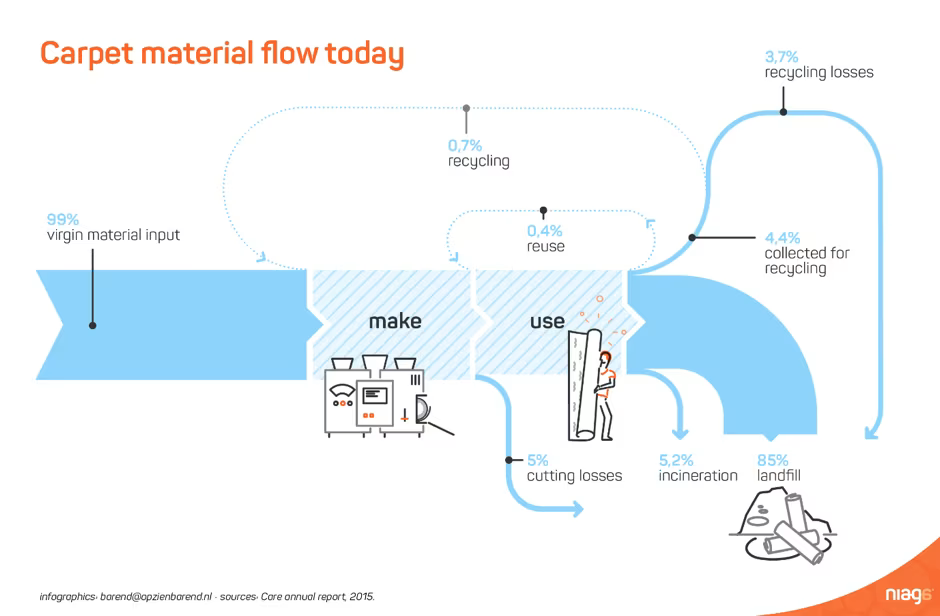
Medium-Life Bulky Products, or MLBP's, such as mattresses, carpets, and cushions, contain a large amount of material that, at the end of its life, is ultimately taken to the landfill. In addition to the sheer amount of material waste, the materials themselves often contained chemicals that would go on to leach into the landfill and the environment.
Niaga, a design technology company, was created as a Business to Business model that sought to develop material and product manufacturing processes that would mitigate these negative environmental and health impacts.
It all started with a fascination among the co-founders of Niaga®, about how product innovation was dominated by constantly adding extra ingredients, to the point where nobody understood exactly what was in the products.
In studying these MLBP's, Niagara founders created 3 design principles for which they would base their work on:
- Keep it simple - use the lowest possible diversity of ingredients
- Clean materials only - use only materials that have tested positive for impact on human health and the environment
- Use reversible connections -connect different materials in a way that allows easy disconnecting at the end of each use phase
In following these principles when developing material technology, they have successfully created technological processes for manufacturing these MLBP's in a more sustainable fashion.
The carpets are created out of single or simple combinations of materials, either pure polyester or a mix of polyester and polyamide, or wool. In the latter case, the two layers are bound together with a reversible adhesive. The holistic design means value is preserved and production costs are reduced for the next generation of carpet products.
Low material diversity and clean materials are, by themselves, excellent design decisions to make not only because it makes the recycling process easier, as a mixture of materials and contaminants make the material difficult to work with, but in that it is also ensuring that we are keeping toxic chemicals out of landfills and the environment.
Niaga, however, as a design technology company, saw a need for technological innovation within how these materials were assembled.
Applying these principles, Niaga® makes products healthier and fully recyclable, without compromising on performance. All used materials can be decoupled after use. This is made possible through an adhesive that Niaga® has developed which can be reversed at a certain frequency or temperature. The separated pure materials can then be fed into the next manufacturing cycle.
Most recently they have partnered with ECOR, to rethink the way that building materials are laminated, so that they can be easily disassembled and recycled. The partnership, focusing on particle board and panel materials used in furniture and construction, has already yielded the Niaga-ECOR Panel (photo below). The panels have laminated surfaces that can be easily 'un-clicked' using microwave frequency to separate panels from veneers, meaning the bulk of the material can be retained in multiple use phases.
Review
It is with these technologies in adhesion and adjoining methods, that we see how significantly and successfully Niaga is participating in a circular material economy. The very essence of these easily reversible methods of joining materials means that these technologies can be utilized in the designing of products that are modular, which can contribute to not only easier recycling, but can be utilized to reduce the amount of waste that would even need to be recycled in the first place. I think an argument can be made that they might not be contributing directly to any loops in particular, as they simply create and sell the technology that any company can then use to create their products, the other side of this argument touches on a very important aspect of circular economies, and that is scalability. These technologies, by the logic of a B2B model, have infinite scalability that they can be applied to, and thus, make it so significantly and successfully a contributor to many circular economies.
Reference
Ellen MacArthur Foundation. (2021, June 17). Redesigning medium-life bulky products from scratch. https://www.ellenmacarthurfoundation.org/circular-examples/redesigning-medium-life-bulky-products-from-scratch



