
Tackling the Challenge of Mass Casualty Triage with Technology
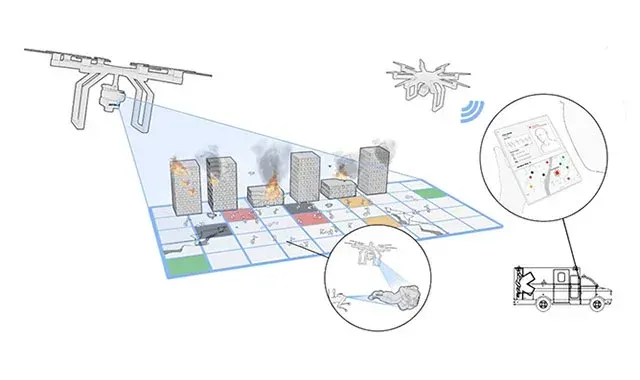
Mass casualty situations are challenging and unfortunate to navigate. In order to save the most lives, efficient triaging and proper, timely care must be given. Battelle is tackling this issue head on in the DARPA Triage Challenge. The team is developing solutions for two phases of triage: primary and secondary triage.
For primary triaging, the team is developing air- and land-based autonomous vehicle systems that will help first responders safely locate and identify casualties and the injured. These systems will be equipped with a various array of sensors like ultrawideband radar and electro-optical imaging. The sensors will help identify any pertinent health information for triaging.
For secondary triaging, the team is developing a decision-making algorithm that uses existing patient information and live information from sensors to diagnose which interventions will be necessary. Potential use cases for this system include ambulances and hospitals. Using Battelle’s own statistical process control method, the system will be able to filter out any inaccurate data from misplaced sensors or background interference. These applications of technology have a great potential to save lives beyond the mass casualty demographic. One way I could see this coming into action for the everyday person is for those in remote settings, whether someone gets injured backpacking or lives hundreds of miles away from the nearest hospital.
The human emotional element and decision regret have a high mental health impact on first responders. Having a collaborative decision support system will simultaneously make the response more efficient and much less stressful for those responding.”
Ensuring the physical and mental wellbeing of first responders is critical to reaching and saving as many people as possible.
Using remote sensors, the goal is to keep first responders out of harm’s way, collect data beyond human capacity, rapidly distill vast amounts of information, reduce cognitive load, and assist on-site clinicians in making timely and informed decisions in complex and stressful situations.
Mitigating human error for precise care in these high-pressure scenarios is vital for saving as many lives as possible. More accurate diagnoses will also help in limiting unnecessary interventions that could put more risk on the individual and caregiver.
Battelle is developing an algorithm for secondary triage to support decision-making once a patient is attached to contact sensors, such as those in an ambulance or hospital. Using a data fusion approach, the algorithm will look at a wide range of information from electronic health records (EHRs) and real-time sensors, demographics, known injuries, preliminary tests, and vital signs to predict which patients need life-saving interventions and when.
This sensor and algorithm system could have a huge lifesaving impact for those receiving care for major medical issues at home.
The team will use a statistical process control method, developed initially as part of Battelle’s NeuroLife® technology, to remove inaccurate data from incorrectly applied sensors or other background interference.
A very important feature to identify any misdiagnoses or false alarms. This should be adopted throughout more medical interventions.
Reference
Insider, B. (2024, May 30). Tackling the challenge of Mass Casualty Triage with technology. Inside Battelle. https://inside.battelle.org/blog-details/tackling-the-challenge-of-mass-casualty-triage-with-technology
No generative AI was used in the writing of this post



