
The Circular Economy of the Toronto Tool Library
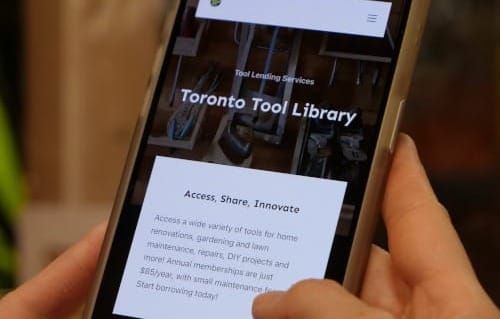
The Toronto Tool Library and Makerspace, founded in 2012, creates an opportunity for a local shared pool of resources for anyone who wants to get crafty.
Here’s one you’ve heard before: the average drill is used for just 13 minutes in its lifetime. Yet many of us possess our own drill. So what if you could see which tools and toys your friends and neighbours owned, and borrowed from them? (Ellen MacArthur Foundation, 2021).
When most people are planning a home improvement job, they don’t just need a drill. More often than not, they’ll need a range of different tools and supplies. For instance, to make and install a home-made shelf you'll potentially need 10 items including a power drill, circular saw, work table, sander, tape measure, level, drill bit, screwdriver bit, safety glasses and perhaps a ladder (Ellen MacArthur Foundation, 2021).
It all started when [Ryan] Dyment saw a video about one of the first tool libraries, which sprang up in Berkeley in the 70s. Being inspired by this model, he pitched it to his team at the Zeitgeist Movement, and a small non-profit was born (Ellen MacArthur Foundation, 2021).
The assumption that there were too many unused tools already was proved correct, and the inventory began to grow. Various media attention followed, which stimulated further donations, and Dyment says it got to the point where the phone was ringing off the hook with people saying “please take my tools!” (Ellen MacArthur Foundation, 2021).
This whole process could be made easier if tools were designed to be treated in this way, and we can look to popular bike sharing schemes for examples of how shared use business models can influence product design. Bikes like those used in cities like London and Paris might not be the most attractive or high performing, but they are designed for utility and intensive use. This means they might be more durable, have fewer moving parts and require less maintenance such as oiling or puncture repair. This approach could be applied to tools too (Ellen MacArthur Foundation, 2021).
Tool-sharing services are nothing new; they have been around for longer than 50 years. However, this article highlights that peer-to-peer sharing services, for example, renting a specific tool, aren't always in your best interest, especially when working on a large project. This is why Ryan Dyment took the idea of the tool library and adapted it to fit his city.
It's interesting to think of a circular economy not focused on renewable resources, but rather focused on the act of reusing tools as services. The Toronto Tool Library is a great example of how to get people involved in creativity by giving them easy access to what they need, as well as teaching sustainability practices by engaging in the circular economy.
References
How tool sharing could become a public utility: Toronto Tool Library and Makerspace. (2021, December 1). Ellen MacArthur Foundation. https://www.ellenmacarthurfoundation.org/circular-examples/how-tool-sharing-could-become-a-public-utility



