
The Sky We're Choosing to Lose
A fan-favorite app in my family is the stargazing app: point it skyward and it names the stars, planets, and constellations above you. Lately, more of those "stars" turn out to be satellites, stretched into long, dotted lines.
That's where this project started to feel hopeless. Light pollution used to be confined to Earth, and companies promised it wouldn't reach the sky too. That promise is already broken and measurable: the night sky you grew up with won't be the next generations.
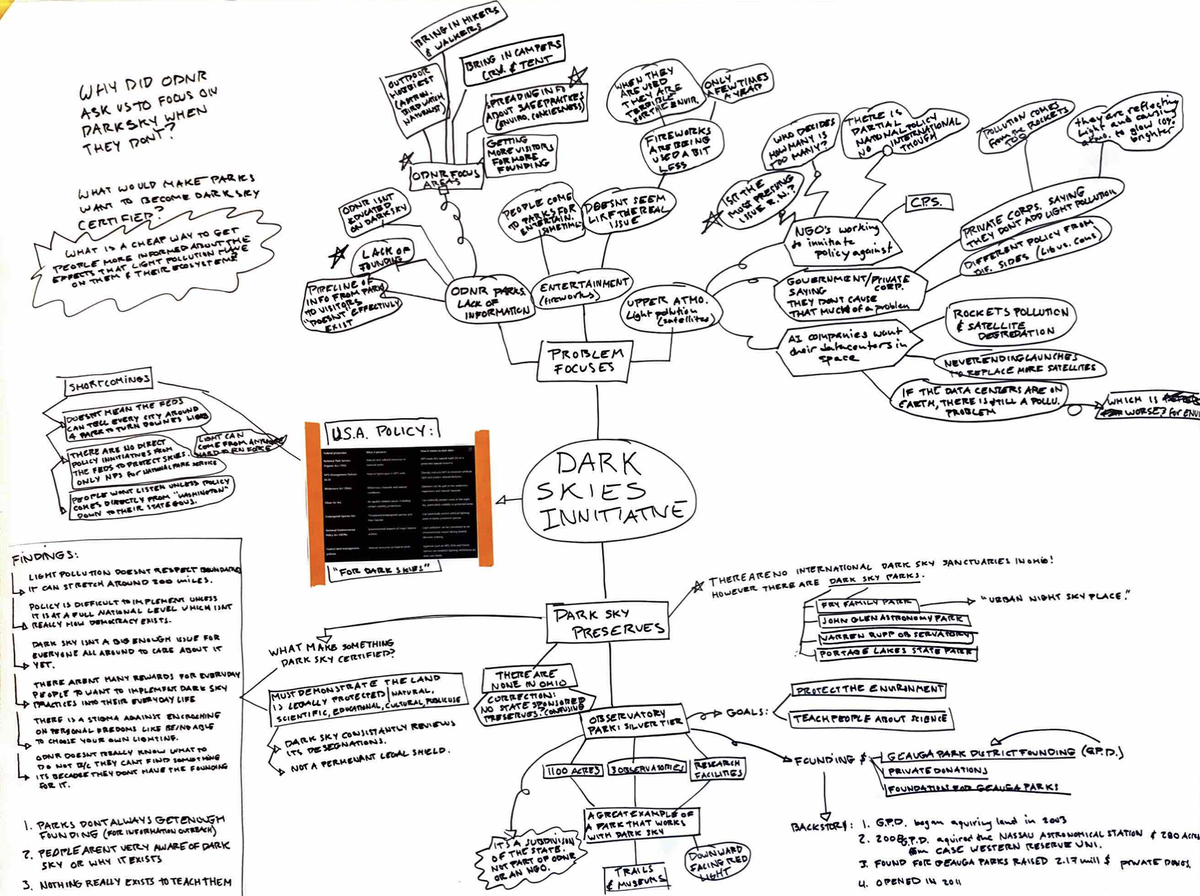
A group of myself and four other Industrial Design students at Ohio State partnered with Heather Bokman, ODNR's Sustainability Coordinator, and Tracey Coe, ODNR's Clean Marina Coordinator, to see how our perspectives could apply to the dark and quiet skies movement, on the ground and in the air. These are complex issues, but we hoped design might offer a new angle on something policy and engineering hadn't fully solved alone.
Three things changed my mind about whether any of this was actually possible.
The first was watching what happens once people understand what's being lost. Bryan Boulanger, a civil engineer who's spent a decade helping parks reduce light pollution, put it simply: "I think you have to meet people where they are, right? It's not actually about preaching, but what values do people have?"
The second was learning where the movement's money comes from. I'd assumed dark sky advocacy ran on goodwill. It doesn't: much of its funding comes from the lighting and electric industry itself. As Boulanger said of DarkSky International, "They were funded by the lighting industry. So they still are, and it's still one of their biggest advocates is the lighting industry."
The third was realizing change doesn't wait on a law. I'd assumed that without national policy forcing every park to comply, nothing could move. But it's small steps from whoever is in a position to take them: a biologist telling a better story, a manufacturer building a better fixture, a park manager trying a sign instead of a rule.
Why I thought dark sky was too big a problem
The first assumption I let go of was about policy. I thought that with no real policy keeping light pollution down, nothing could be fixed. I wasn't entirely wrong: federal tools like the Organic Act and NEPA protect some resources, but none require a park to reduce its lighting, and Ohio has no equivalent state requirement. Not enough policy exists yet to make a real impact.
Next was funding. Parks don't have much to spare, so what are they supposed to do about dark sky if they can't afford to talk about it? But certification brings astrotourism, and parks can apply for outside grants meant for dark sky work instead of thin budgets.
I also spent a while unsure who the real stakeholders were. The honest answer: everyone is, because everyone benefits from seeing the stars. That's a wide net, but it means the movement doesn't hinge on convincing just one group.
Then there was entertainment. I assumed fireworks and drone shows were a massive part of the problem. They're a smaller piece than expected, and it's shifting. Fireworks are bad for the environment: the CPSC recorded 9,700 ER visits and eight deaths from fireworks in 2023 alone, mostly from misuse, and estimated 18 percent of fireworks on the market didn't meet safety standards (Blakemore, 2024). So I surveyed ODNR park staff directly.
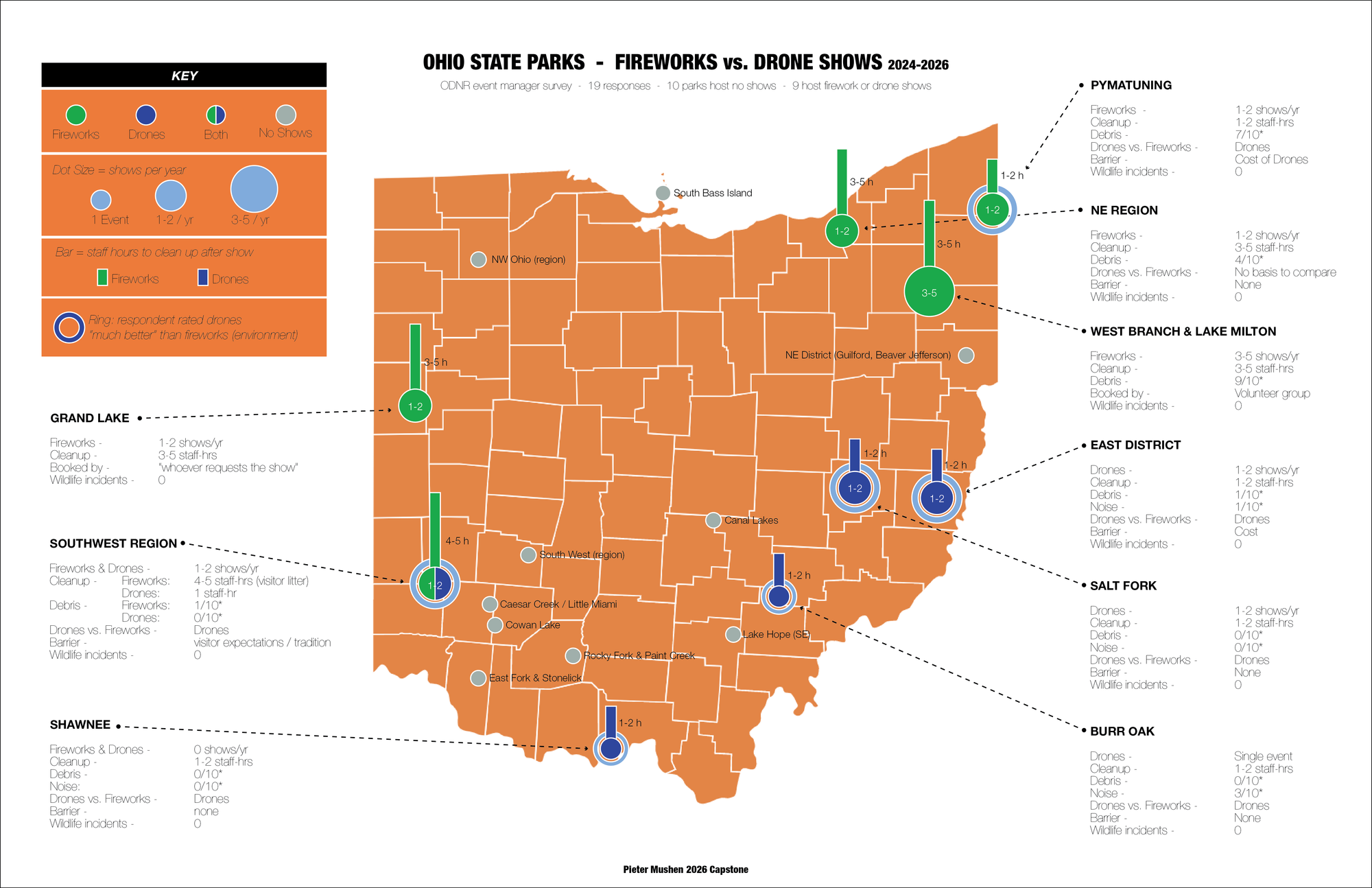
Of the 19 who responded, only 9 parks host shows at all, and among those, drone shows cost less in cleanup time and rated far better environmentally. Seven of eight who compared the two called drones "much better," none rated them worse. Fireworks aren't the whole problem, but where a park has a choice, the data already points to the better option.
And then there was the one that actually is as big as it feels: satellites. Companies like Starlink are sending thousands into orbit, adding to a broader skyglow. As of February 2026, roughly 14,000 active satellites are in orbit, with another 1.23 million proposed (Radisic & Lawler, 2026). This isn't something a park, or even a state, can fix on its own.
What other places are already doing
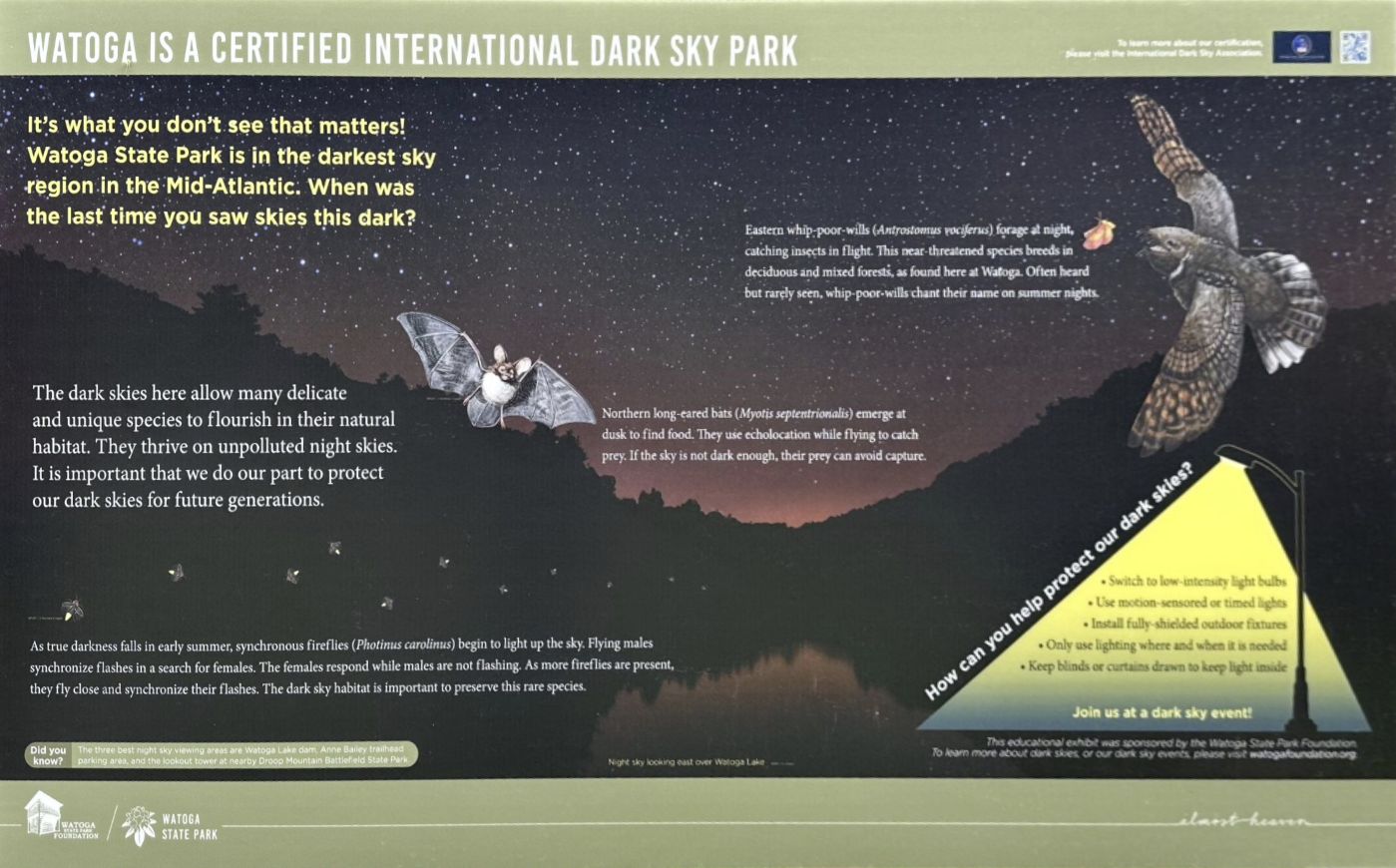
Once I understood the problem's shape, I went looking for places already doing something about it. Watoga State Park in West Virginia was the first site in the state certified as a Dark Sky Park. Certification wasn't quick: "The application for certification took four years to complete, was 110 pages long and included requirements of four educational programs per year which the Star Party is one. These programs are free to the public" (Cleaton, 2022). It told me something small: a park doesn't need to be well resourced to pull this off, it just needs to see it through.
Boulanger's second example wasn't a park or a policy, but a method: show, don't argue. "I think the most impactful thing was just showing satellite imagery. The data that says, okay, here's the light as it was 10 years ago, and here's the light as is today. It's grown, right?" That mindset doesn't require new staff or policy, just pulling existing imagery and laying two years side by side.
On the satellite side, the closest thing to a coordinated response is the International Astronomical Union's Centre for the Protection of the Dark and Quiet Sky (CPS), formed in 2022 and recently granted a five-year funding extension. "The core mission of the CPS remains essentially the same: to raise awareness of the impact of satellite constellations on professional and amateur astronomy and people's enjoyment of the night sky, and propose good practice and regulation" (CPS, 2025). It's not a law, but it's the first real attempt at a unified voice on this issue.
What everyone gets from dark sky
The more I looked, the more I realized dark sky isn't just a sacrifice for parks, it comes back to them too. Northumberland's dark sky tourism generates roughly £25 million a year and supports about 450 jobs, returning £1.93 for every £1 spent on compliant lighting; Utah's Colorado Plateau generated $5.8 billion in dark sky–adjacent tourism over a decade (AstronEra, n.d.). Certification is an economic win too.
It also comes back to something harder to measure. At this rate, kids growing up now may not get the same night sky their parents did. As Boulanger put it: "Can Ohio continue to be a space leader if our kids can't even see the stars?"
And it isn't only about us. Lit fields see 62% fewer nocturnal pollinator visits and 13% less fruit set, and pollinators service roughly 30% of crops. Migratory birds are especially exposed: more than a billion die annually in light-linked building collisions (AstronEra, n.d.).
There's one more piece, light also means less pollution. Reducing outdoor lighting isn't only about the sky, it's tied to energy use too. As one estimate puts it, outdoor lighting in a region can carry tens of millions of tonnes of CO2 per year from grid emissions, much of it reducible through shielding, correct color temperatures, curfews, and retrofits (AstronEra, n.d.). Cutting unnecessary light pays for itself twice over.
What we can design to help
By this point I'd stopped looking for one solution and started looking for what I could actually design. If certification and policy move slowly, and satellites are out of anyone's hands, the question I kept returning to was: what are cheap ways to get people more informed about dark sky, and what light pollution does to daily life and ecosystems? Three answers came out of that.
The first was Watoga's own answer: a sign built around a nighttime photograph of the park, explaining why the darkness is worth protecting and offering suggestions rather than rules. I built on that with the Dark Sky Camp Lamp, a lantern with built-in light sensors that notice when a site's lights stay on too late, and gently prompt guests to dim or switch off. It doubles as its own light source, a soft, hooded glow that gives campers what they need without spilling into the dark around them.
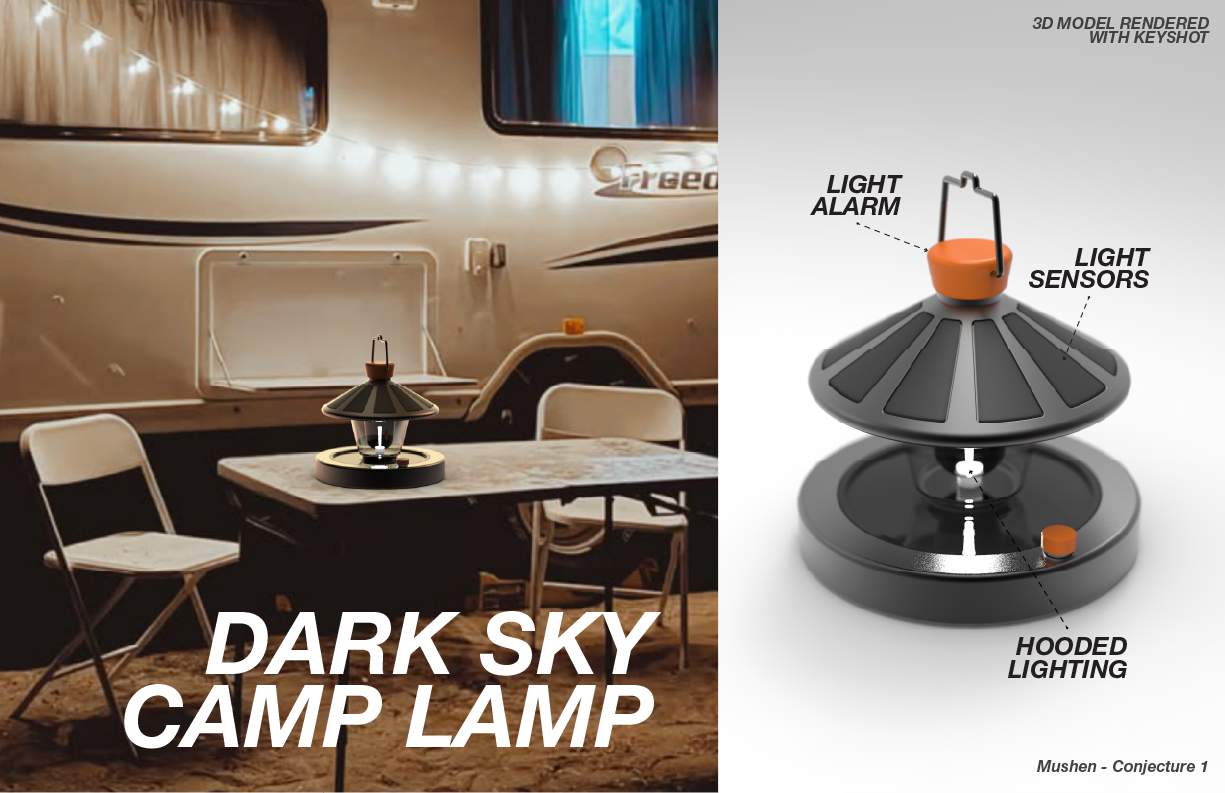
It isn't a perfect fix. Some guests may see it as an intrusion, and outfitting every site is a real cost. But it moves the effort onto the design itself, a trade worth making.
The second came from Boulanger, who pointed me toward places where better design, not just fewer lights, is the answer: marinas and parking lots. "It's not solely turning them off. It's directing them downward and using better color temperature lamps, right? People can have light." Sometimes that means better-designed fixtures; sometimes it means removing lights a marina never needed.
The third was the hardest to pin down: designing more ways for people to understand this. The Watoga sign and the Camp Lamp are both attempts at the same goal, education that doesn't feel like being lectured. An infrared projector became my further step for parks that host evening entertainment, projecting in wavelengths outside what most animals detect, with audiences viewing through infrared glasses.
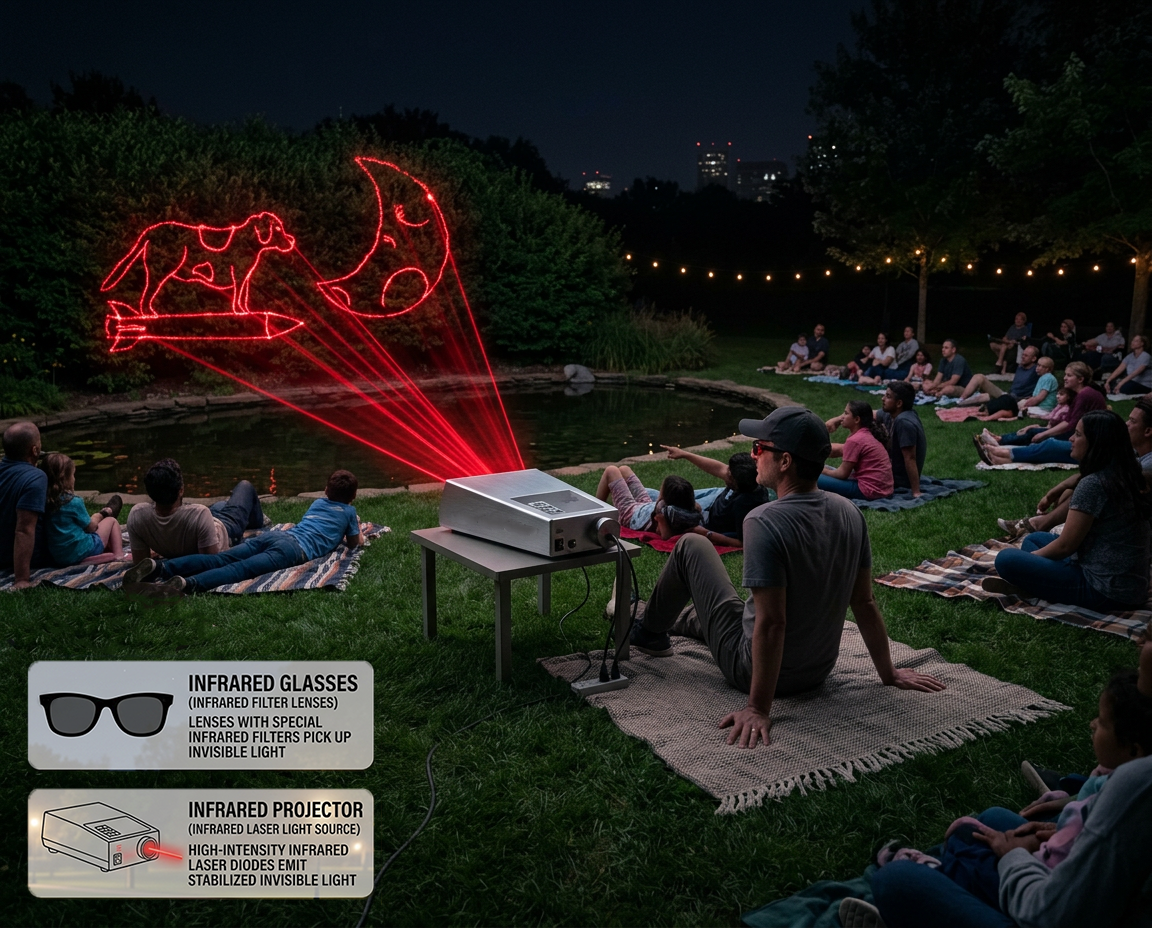
It has real limits: some nocturnal insects and mammals can detect near-infrared light, the glasses add cost, and they cap audience size. Still, it's a useful example of designing from the constraint instead of the spectacle.
What everyone can do
None of this requires waiting on ODNR, a grant, or a certification process. Angle outdoor lights downward. Turn them off when nobody's using the space. Choose warmer, correctly rated color temperatures over harsh white ones. Boulanger's own math: a fixture can be improved for around $100, and a park tackling two fixtures a year solves the problem within five years.
I started this project thinking I was looking for one big fix. There wasn't one. There was a sign, a lamp, a better-angled floodlight, a satellite imagery comparison, a five-year plan for two fixtures at a time. None of it is dramatic. All of it adds up. The next time your stargazing app names what's above you, the goal isn't a perfect sky, it's just one with more room for actual stars.
References
AstronEra. (n.d.). Research. Retrieved September 15, 2026, from https://astronera.org/research
Bateman, P. W., Gilson, L. N., & Bradshaw, P. (2023). Not just a flash in the pan: Short and long term impacts of fireworks on the environment. Pacific Conservation Biology, 29(5), 396–401.https://doi.org/10.1071/PC22040
Somvichian-Clamani, D. (2023, July 3). Air quality plummets after July Fourth fireworks. Could drone displays be the future? NPR.https://www.npr.org/2023/07/03/1185815745/air-quality-fireworks-smoke-july-fourth-drone-displays
Boulanger, B. (2026). Personal interview [September 23, 2026]. Ohio Northern University.
Cleaton, C. (2022, September 7). Star party on Droop a stellar success. West Virginia Daily News. https://wvdn.com/42704/
Centre for the Protection of the Dark and Quiet Sky (CPS). (2025, September 18). Centre for the Protection of the Dark and Quiet Sky secures five-year extension. https://cps.iau.org/news/centre-for-the-protection-of-the-dark-and-quiet-sky-secures-five-year-extension/
Radisic, G., & Lawler, S. (2026, February 18). Too many satellites? Earth's orbit is on track for a catastrophe — but we can stop it. The Conversation. https://theconversation.com/too-many-satellites-earths-orbit-is-on-track-for-a-catastrophe-but-we-can-stop-it-275430



