
The warm glow people get from recycling has a downside.
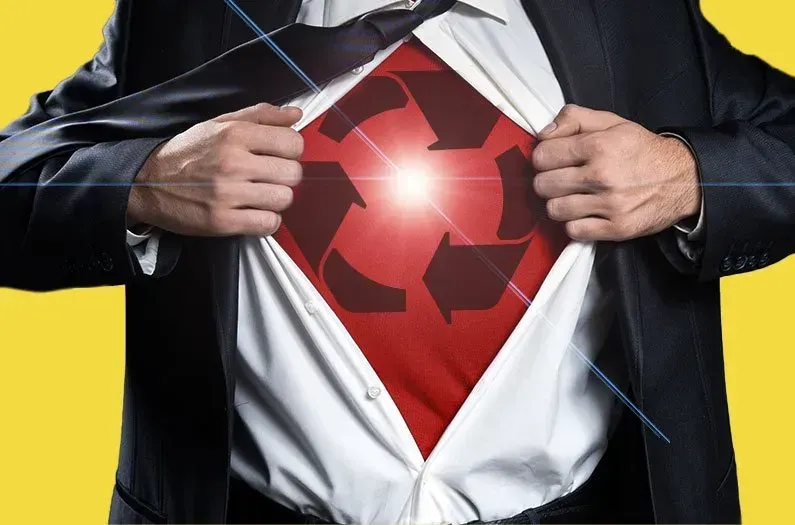
In the face of talking about what would be considered the "best" answer to our waste problem, most individuals would initially answer that it is to recycle. If we can take everything we use, and have that be made into something new, such as new materials, fuel, etc, that would be ideal. But, this idea, and romanticization of recycling can sometimes become a Catch-22, a study reveals.
The findings suggest that touting efforts to recycle waste into useful products may paradoxically make people perceive generating waste as the more sustainable option. “People may come to psychologically frame their waste creation as a contribution to the collective good that makes them feel good about themselves,” researchers write in a paper published in the Journal of Environmental Psychology.
In laymen’s terms, this “warm glow” of positive feelings that recycling generates, can often mean that we pay less attention to what waste we do produce, because it will be recycled anyway. This psychological trap means that we as a society will stay wasteful, and ambitions of being less wasteful to begin with fall into the background.
The results “suggest that the warm glow induced by a recycling option may indeed lead participants to exert less effort to avoid creating waste in the first place, although they are well aware that this would be the most responsible thing to do in its absence,” the researchers write. “People convince themselves that discarding waste represents a more moral act than avoiding the generation of the waste in the first place.”
In knowing that this psychological phenomenom exsists, researchers presented an affirmation towards both behavioral change and recycling efforts.
The results suggest that sustainability communications should focus on encouraging people to reduce waste, rather than advertising the new products that can be made from recycled materials. Not that we should stop making recycled products – but that we shouldn’t hold them up as the pinnacle of sustainability, or an end in themselves, the researchers say.
Review
This concept, prior to reading this article, was one that I was whole-heartedly unaware of. In fact, I am still struggling to wrap my head around it. In their study, they used cookies as a stand in for a waste product. They claim that the results of the study show that when told if they throw away the cookie, it would turn into biofuel, meaning that individuals would more often throw away the cookie, than save it for someone else to eat, because it was seen as a more moral option. Now, as a self identified “Philosophy Person”, this doesn’t make much sense to me. When framed within absolute moralism, saving the cookie for someone else is the more morally correct choice in that it has a greater moral outcome. Saving a cookie, means someone else gets a cookie. When it is turned to biofuel, it contributes a small amount to biofuel, which in turn, cuts down on the moral implications of a singular cookie. However, regardless of my disagreements with the moral rationality of the experiment participants, I think the results of such a study should absolutely be considered when it comes to waste management efforts.
Reference
DeWeerdt, S. (2021, October 26). The warm glow people get from recycling has a downside. Anthropocene Magazine. https://www.anthropocenemagazine.org/2021/10/the-warm-glow-people-get-from-recycling-has-a-downside/



