
The Weakly Recycler: Bag of Holding
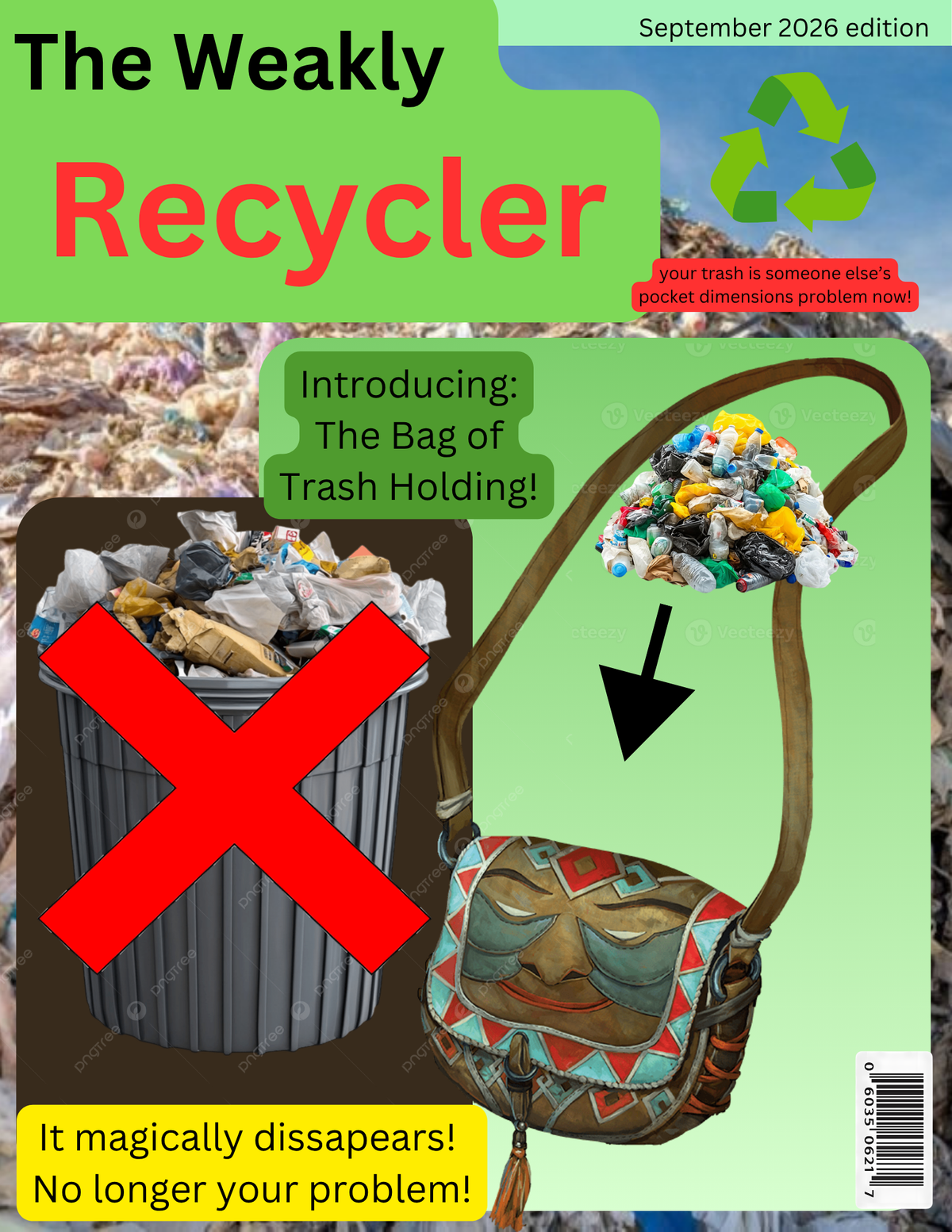
In my own review of Setting Up Camp by Joe Selmont, I criticized the piece on one main point: Increasing the general public’s knowledge of our waste problem is largely ineffective for promoting real change. This is because while most people care about this topic to some degree, their main issue with being more sustainable individuals lies more so with factors outside of their control: Knowledge of recycling programs, and access to those resources.
In my attempt to “do one better”, I kept a couple of key factors: The tabloid style of the original art piece, and the cynical nature of the contents. In attempting to switch up the subject, I instead decided to pivot the content to focus on something that is actually more feasible to produce results on this individual level.
This switch in subject points to this idea that most people genuinely don’t think about where their trash goes after they dispose of it. The bag of holding, much like the Kraken, is a well known sort of fantasy “item”. While the Kraken is confused by the amount of trash in the ocean, the Bag of Holding holds a mirror to this forgetful behavior. In examining this artifact, it prompts the user to think about how this subject, while initially seemingly silly, is similar to how we actually treat trash.
If we can prompt individuals to learn more about what happens to their trash when it is disposed of, the hope is that those individuals would then also be compelled to gather the knowledge needed for themselves to contribute less waste to landfills.
Review
When looking at this piece objectively, I think as a stand alone piece, it does effectively do as plainly intended: It is reflective of popular trends that show that most people do not think about their trash after they have thrown away those items.
However, where it begins to fall short is how easily this message might be ascertained. When we hide these sorts of messages behind a wall of cynicism, especially in one that might seem initially humorous, we likely won’t have nearly as fruitful conversion over to those individuals getting the “deeper” meaning. It would be quite easy for an average reader to view this, perhaps laugh, and like the trash they dispose of so easily, also disregard this piece before they have thoroughly considered it.
In a world with fast fashion, ever changing trends, and a disposable driven consumer ideology, this cynicism, while maybe producing cathartic effect for the producer, often becomes another barrier that individuals must have the resources and effort to overcome in order to manage a meaningful result.
Reference
University of Washington Recycling. (2025, April 15). 2025 Trash Art Contest winners repurpose waste into thoughtful art. UW Sustainability. https://sustainability.uw.edu/blog/2025-trash-art-winners



