
Use of Mobile Technologies to Streamline Pretriage Patient Flow in the Emergency Department: Observational Usability Study

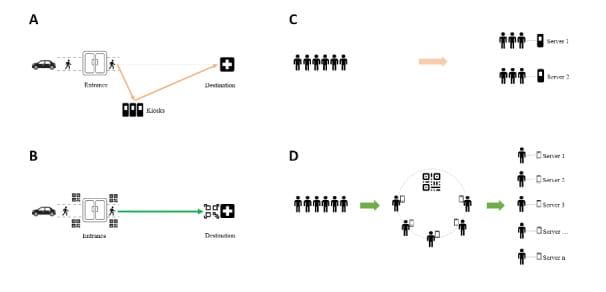
“In emergency departments (EDs), triage nurses are under tremendous daily pressure to rapidly assess the acuity level of patients and log the collected information into computers. With self-service technologies, patients could complete data entry on their own, allowing nurses to focus on higher-order tasks. Kiosks are a popular working example of such self-service technologies; however, placing a sufficient number of unwieldy and fixed machines demands a spatial change in the greeting area and affects pretriage flow. Mobile technologies could offer a solution to these issues” (Wang et al., 2024).
In addition to helping with congestion once arriving at the hospital, I wonder how my project could help apply these findings to pretriage before arrival to emergency medical services. This could help to assist, especially with patients who have already traveled a long distance and extra minutes of entering medical help could be crucial.
“Overall, 5928 of 8575 patients performed self-registration on kiosks, and 7330 of 8532 patients checked in on their smartphones. Referring effort was significantly reduced (43.7% vs 8.8%; P<.001) and mean pretriage waiting times were significantly reduced (4.4, SD 1.7 vs 2.9, SD 1.0 minutes; P<.001) with the use of smartphones compared to kiosks” (Wang et al., 2024).
“When a patient presenting at the ED is seen, others have to wait [2]. During peak hours, pretriage waiting tends to be prolonged and unpredictable [2-4], representing one of the main factors contributing to ED overcrowding [5,6]. An extended waiting time in the ED has been associated with increased morbidity and mortality rates [7,8]” (Wang et al., 2024).
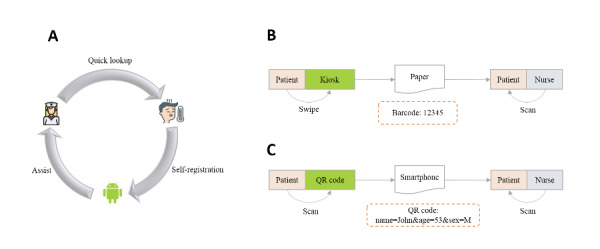
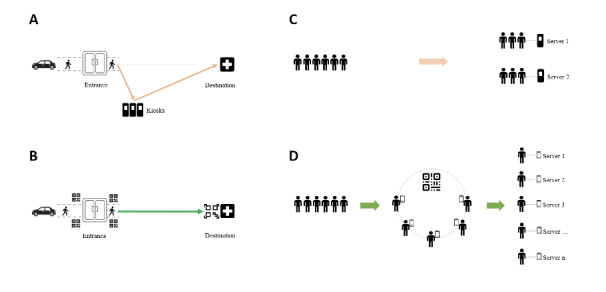
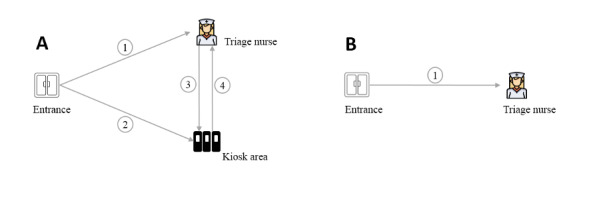
“Compared to the kiosk area, the posted QR symbols appeared to be easily seen by arrivals and then resulted in followers. Assistant B4 described that ‘It is good for patients to find and follow, especially posted outside.’ By contrast, in relation to kiosks, the assistant indicated that ‘the roadmap seems not working that well’” (Wang et al., 2024).
I wonder if easy signage for this could be helpful outside of a hospital as well. Not only could patients complete the onboarding in the emergency room, but QR codes on the signs could gather data and location information about patients before they arrive.
“Assistant A2 commented: ‘It is fine but I have a concern for patient safety when these two lines compete for patients.’ This concern was not found in the smartphone group” (Wang et al., 2024).
“A kiosk might break down at any time. When this occurs, the clinical staff should be notified in a timely manner so that an ‘under repair’ sign can be set up. However, this was not often the case in practice; instead, as described by assistant C3, ‘some patients just switched to another line or simply quit.’ In the case of smartphones, most interruptions were related to a low battery or bad signal. A smartphone failure would not cause a delay for other patients” (Wang et al., 2024).
“Passing through kiosks is helpful for reducing triage burden, but the increased movement within the ED and midway congestion might be detrimental to patient safety [49], especially for patients with potential critical illnesses. Smartphones barely have an impact on the incoming flow. Outside the entrance, scanning takes only a few seconds, and then patients can walk into the ED and complete registration while waiting to be triaged in front of nurses” (Wang et al., 2024).
“Smartphones increase hospitality in the pretriage flow [51]. First, compared to public screens, smartphones honor patient privacy. Second, the use of personal devices ensures hygiene and cleanliness, which are more difficult to maintain when using shared kiosk touchscreens. Third, social distancing is important in the ED, which could pose a challenge when lining up at kiosks to compete for timely identification. Finally, smartphones are more user-friendly in multilingual scenarios” (Wang et al., 2024).
Having more clear and mobile ways to accept patients seems to have proven to be a benifit inside the hospital. I wonder how this could help with people in rural areas, to let hospitals prepare for their arrival in the future. This could especially help if someone does not have access to traditional EMS transportation, as they could still get some information to a hospital just like an ambulance could.
References
Wang, P., Yu, L., Li, T., Zhou, L., & Ma, X. (2024). Use of mobile technologies to streamline pretriage patient flow in the emergency department: Observational usability study. JMIR mHealth and uHealth, 12, e54642. https://doi.org/10.2196/54642
No generative AI was used in writing this article.



