
What Happens to Plastic Under Pressure
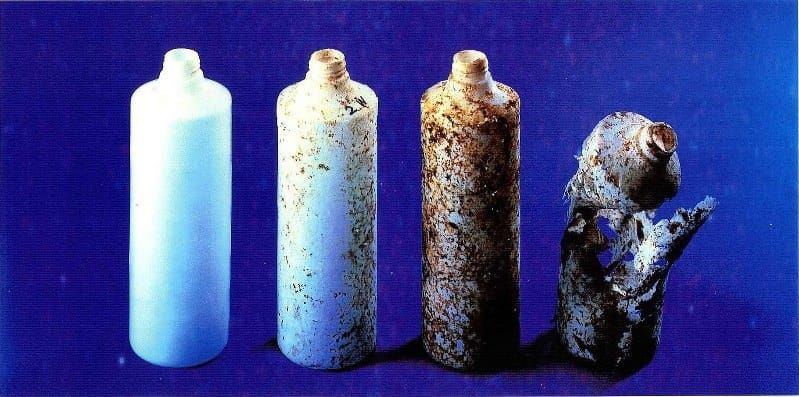
The most important factors affecting degradation of polymers are thermal treatment, amount of shear stress acting on the polymer and residence time ,i.e. the time for which the polymer melt is subject to certain thermal and shear effects (Karlsson et al.2002). PS is known to follow an end-chain mechanism or depolymerization steps resulting in mostly monomeric units as the main product (Peterson et. al., 2001
Fig. 1demonstrated also the behavior of pure polystyrene for comparison purposes. The curves show the same tendency of decreasing the viscosity with increasing number of cycles. We may conclude that the introduction of a rubbery phase alters, however, the stability of the blends in regards to degradation, enhancing the sensitivity of the material to the degradative agents
This work was then applied in a local plant where industrial processing and palletizing equipment were used. Thus, 25% of recycled HIPS were added continuously to the virgin feedstock for periods of one and two weeks. The results of flow property measurements are also shown in
It is clearly seen that these are equivalent to 4 and 6 recycles of 100% HIPS. The main advantage of the plant application was to compare experimental and actual results. It was found that in indoor recycling there was colorstability indicating higher thermal stability and also contamination prevention of the feedstock.
Only the extrusion of virgin material (as granules), showed decreas of shear stresses and decrease of shear stresses and viscosities. This is due to the working pressure for the granules being twice its value for the recycled chips. The results obtained emphasize the role of shear stresses in enhancing chain scission reaction. It can also be concluded that the values of flow properties are a result of factors acting in opposite directions. (Shubbar, 2010).
I thought that this article was useful for my research because it was able to provide a more detailed and technical explanation of the changes that HIPS goes through when they are being repeatedly processed. In the article, it states that the thermal treatment, shear stress, and residence time are important factors that affect the degradation across the repeated cycles. This is important to consider for the Local Loops groups because it makes it clear that the waste cannot be treated as a completely stable material that remains the same every time. When the material is constantly being reprocessed, we have to be aware of the trade-offs and design around the loss and play to the strengths of the material. It also opens up potential avenues for Marble Plastics, where some of the recycled materials could be combined with the virgin materials, not only relying on the fully recycled materials' properties.
References:
Shubbar, S. D. A. (2010). Effect of recycling on rheological and mechanical properties of high impact polystyrene. Kufa Journal of Engineering, 2(2), 103–114. https://doi.org/10.30572/2018/KJE/221278



