
Designed Around the Moments that Matter
Introduction
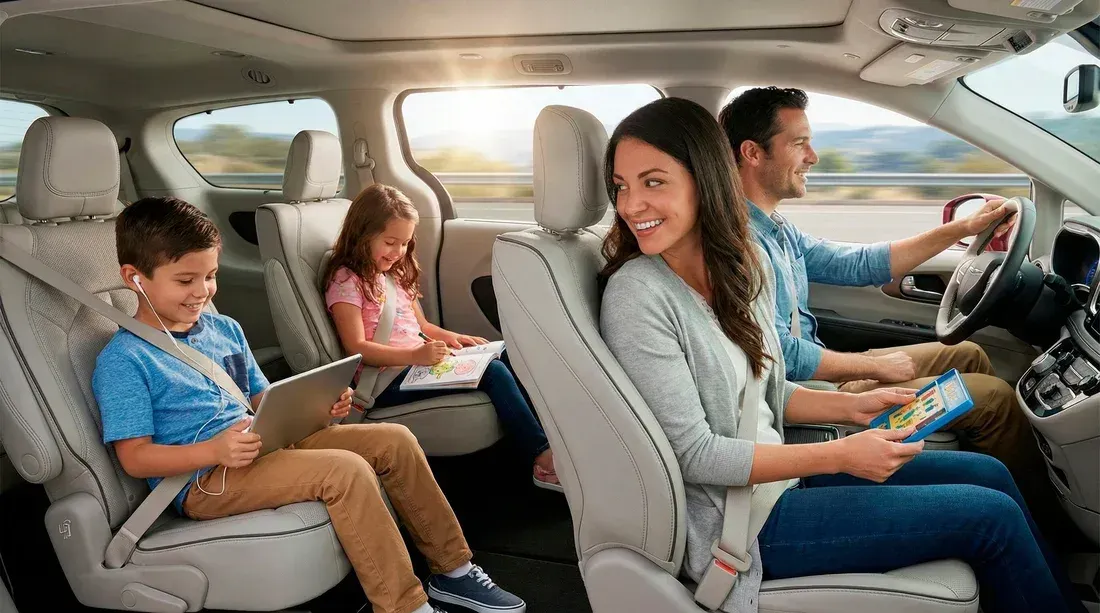
For many families, having a car is an important part of everyday life. We use cars to drive children to school and practices, run errands and go on road trips. But have you ever thought about how different the experience inside the car would be if everyone was not focused on their own phone or tablet? I honestly never thought about it until I started working on my capstone project.
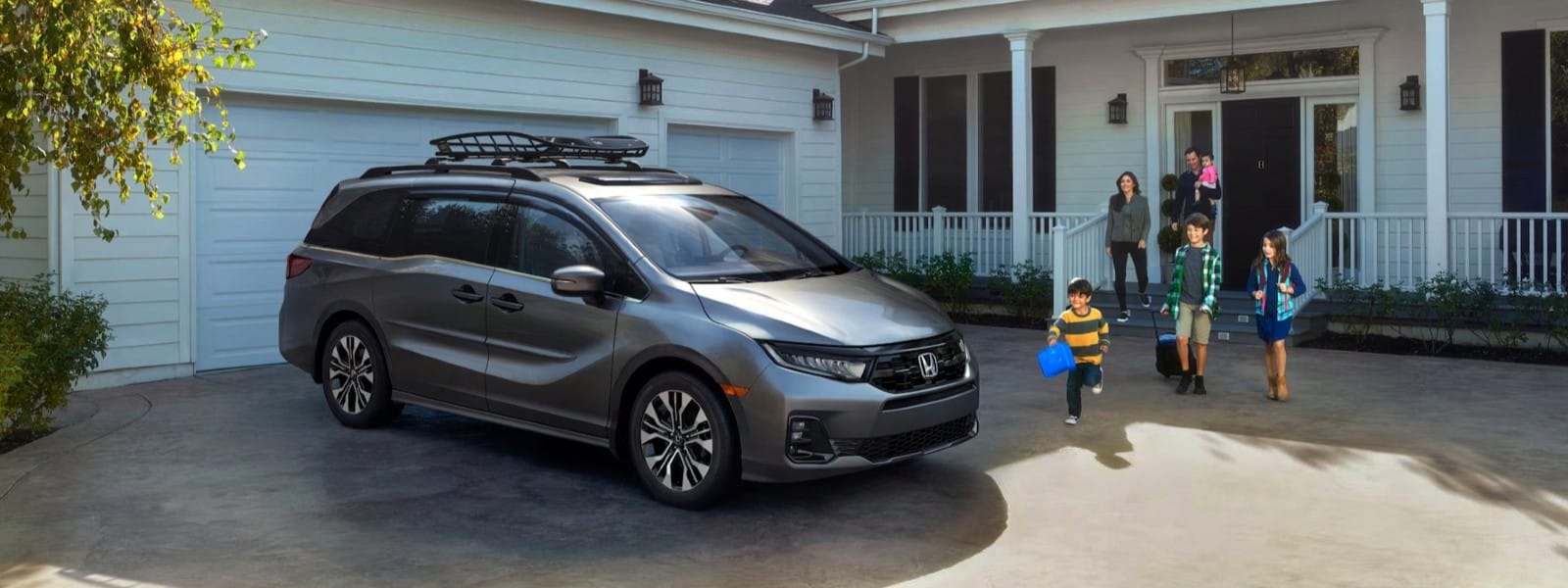
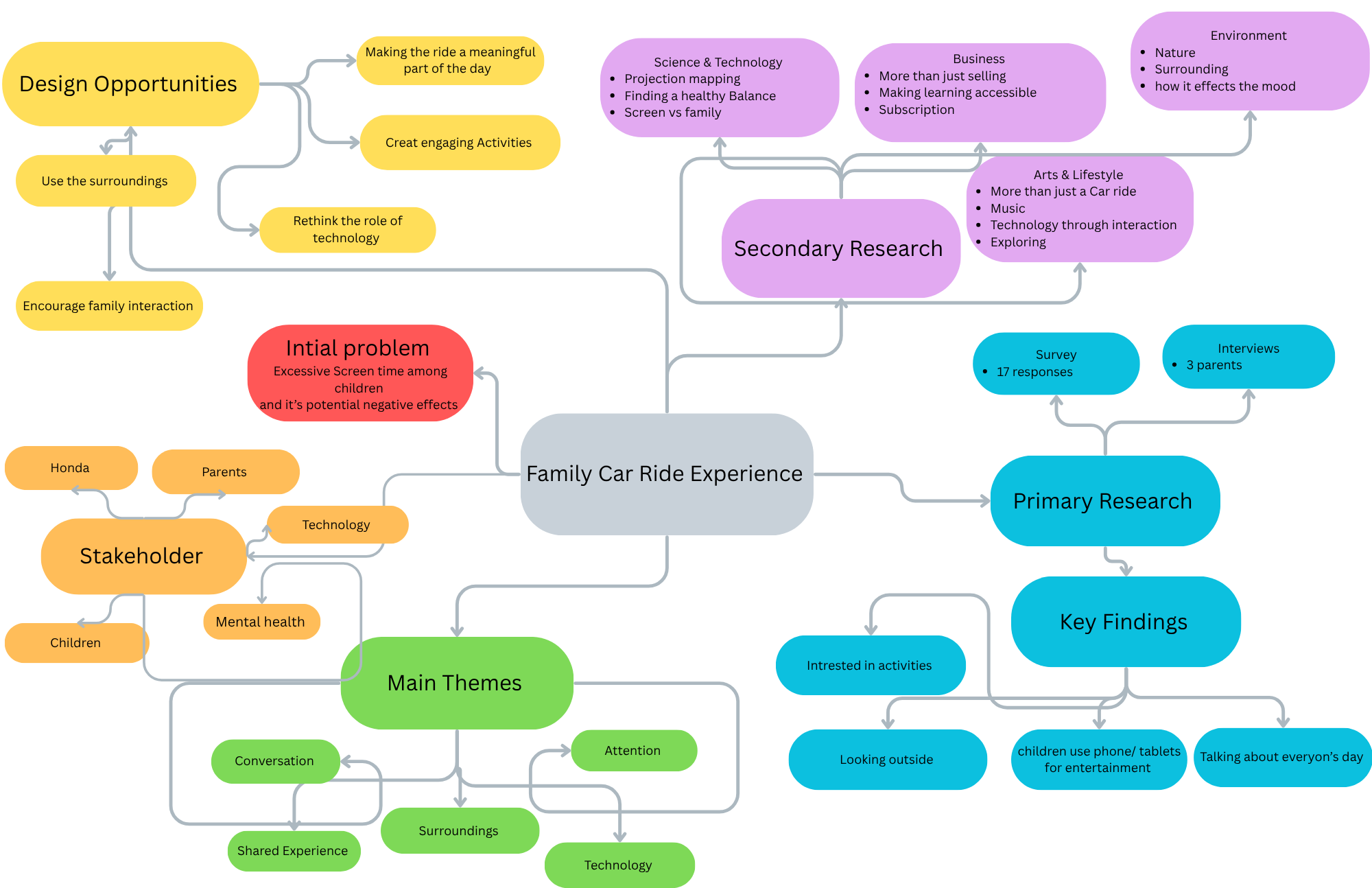
At the beginning of the project, my team and I made our first trip to Honda's Marysville Auto Plant, where we met Kal Whalen, Andrew Barrow, Conner Buel, and Kylie Saner. They introduced us to our capstone project theme, the problem, and some of the opportunities we could explore. One of the main problems we discussed was excessive screen time among children during car rides and some of its possible negative effects, including impacts on development and learning, anxiety, and family dynamics. Our goal was to explore how we could create a better and more connected family experience inside the car, especially for children sitting in the second row.
At first, I thought the project was mainly about reducing screen time. However, as I started doing more research, I realized the problem wasn't that simple. Taking away a screen doesn't automatically mean that a family will connect more.
Understanding The Family Car Experience
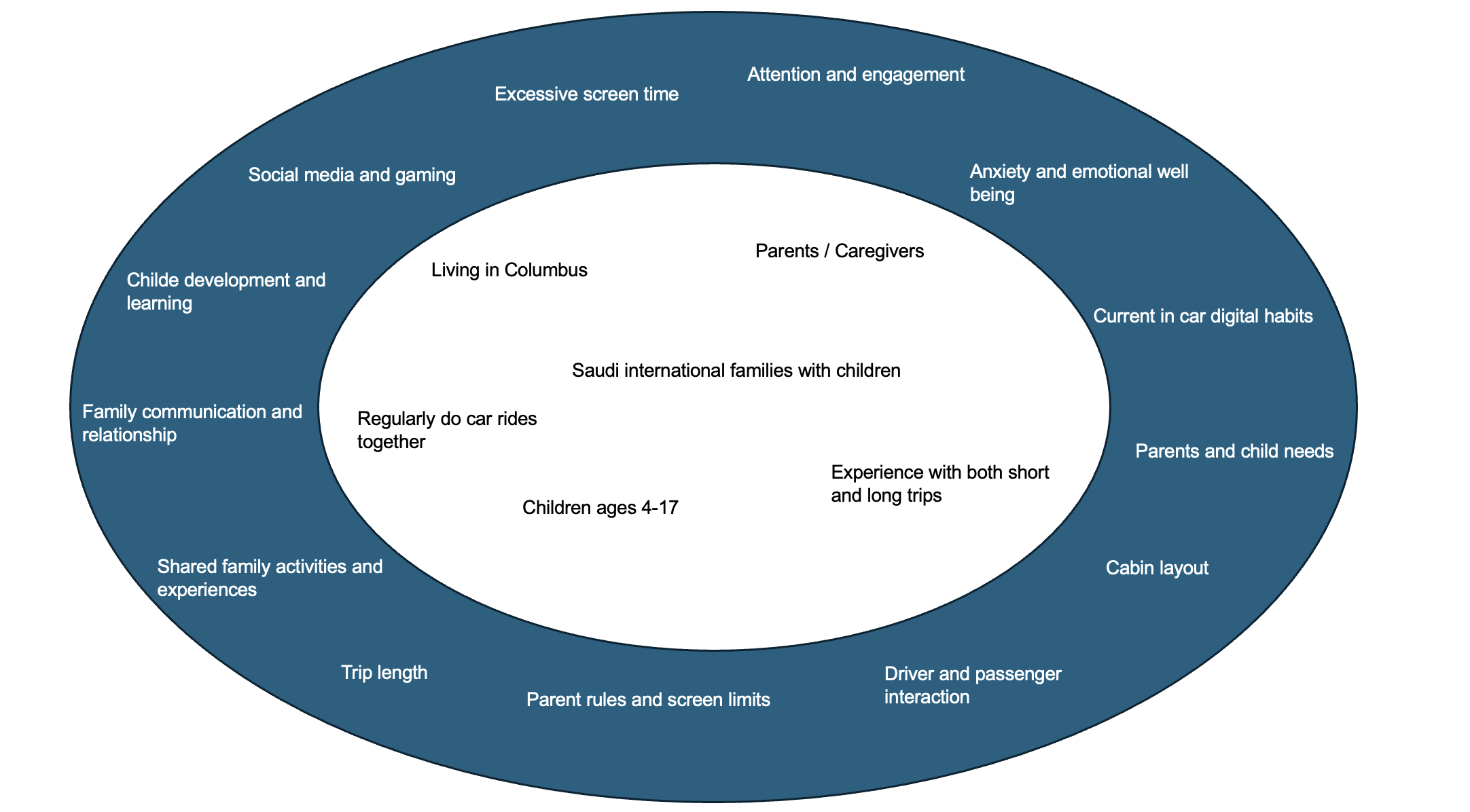
Before I started thinking about possible design ideas, I first needed to understand who I was designing for and what was actually happening during a family car ride. I decided to focus on Saudi parents studying at The Ohio State University. Having a more specific target audience helped me become more intentional about what I was researching and gave me a clearer focus and scope.
A family car ride can look completely different depending on the family, how long the ride is, where they're going, and even what's happening around them. Children might be using a phone or tablet, listening to music, talking with their parents, playing a game, looking outside, sleeping, or simply getting bored. Parents and caregivers are also experiencing that same ride differently, especially if they're driving. This made me think about how the car can be a shared space without necessarily being a shared experience.
This became important when I started looking deeper into screen use. The original problem focused on excessive screen time among children and how it can affect them. But I didn't want to immediately assume that the answer was to completely remove screens. I wanted to understand why children use them during car rides, what they might be replacing, and if there's a different way technology could be used.
For my secondary research, I explored four different areas: Arts & Lifestyle, Science & Technology, Business, and Environment. Looking outside the automotive industry made me see how other experiences encourage people to interact, learn, explore, and connect.
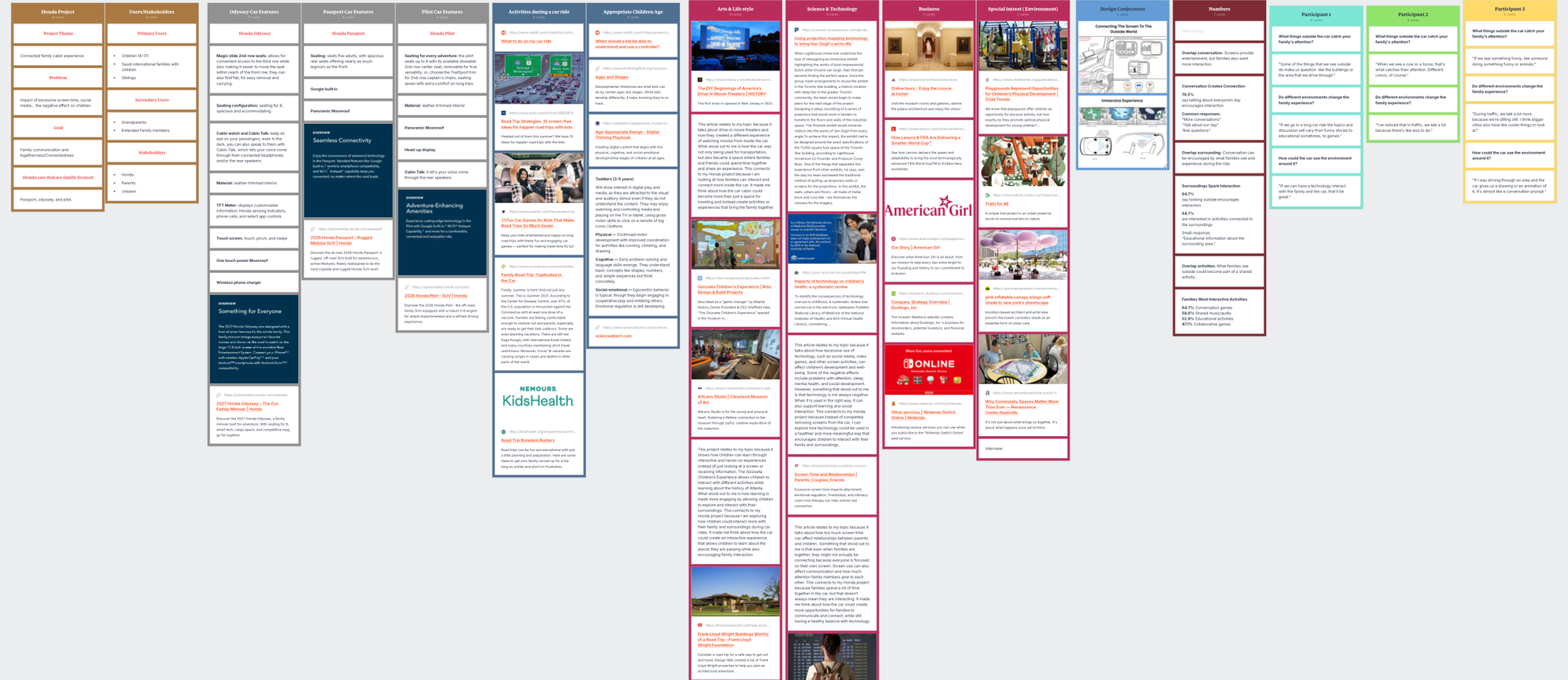
For example, the Goizueta Children's Experience showed me how children can learn through exploration and hands-on activities (Roto, 2025). My research about karaoke showed me how something like music can become a shared activity instead of something one person experiences alone (Co., 2017). The Frank Lloyd Wright road trips research made me think about how many interesting buildings and landmarks families pass during a drive without really noticing them (Milk, 2021).
I also looked at technology in a different way. Research into projection mapping showed me how technology can completely change an environment instead of keeping someone's attention on one small screen (Panasonic Connect, n.d.). Other examples, such as Delta's Parallel Reality technology, also made me think about how digital experiences could be designed differently (Brownlow, 2026).
The research that I did on the environment became especially important to me. It made me think about how the experience of a car ride is not only affected by what is happening inside the vehicle. Traffic, cities, buildings, nature, light, and changing scenery are also constantly surrounding the family during the ride.
At this point, I started asking myself a different question: Is the screen itself really the main problem, or is it more about where everyone's attention is going during the ride?
What Are Families Actually Doing in the Car?
While I was in the process of doing my secondary research, I created a survey about family experiences during car rides and received 17 responses. Out of the 17 response 15 were Saudi and 2 preferred not to say. One of my assumptions going into this research was that international families may experience more long drives or road trips while living and traveling in the U.S. I wanted to see if this was showing in their experiences and, more importantly, what was happening between family members during that time in the car.
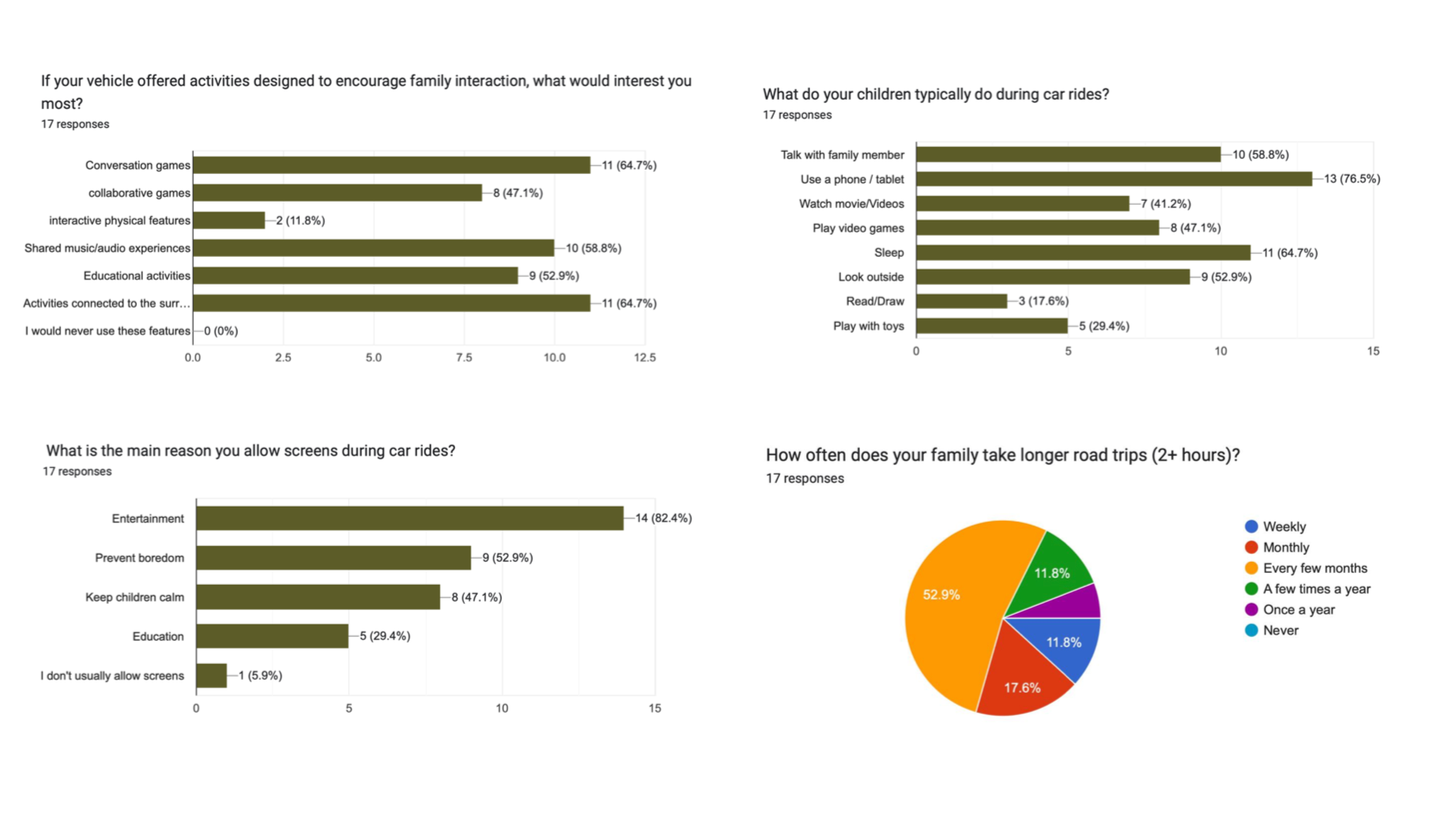
The outcome of my research showed 52% said their family takes road trips longer than two hours every few months, while others reported taking them weekly, monthly, or a few times a year. This didn't necessarily prove that international students travel more than other families, but it did show me that longer car rides were part of the experience for many of the families I surveyed.
Another thing that became very clear was that screens are already a major part of the car experience. 76% of respondents said their children use a phone or tablet during car rides, making it the most selected activity. But understanding why parents use screens was more useful to me than only knowing that they use them.
When I asked why screens are allowed, 82% selected entertainment, 52% selected preventing boredom, and 47% selected keeping children calm. This showed me that screens are actually solving a need for parents. They give children something to do, especially when the ride is long or there isn't much happening.
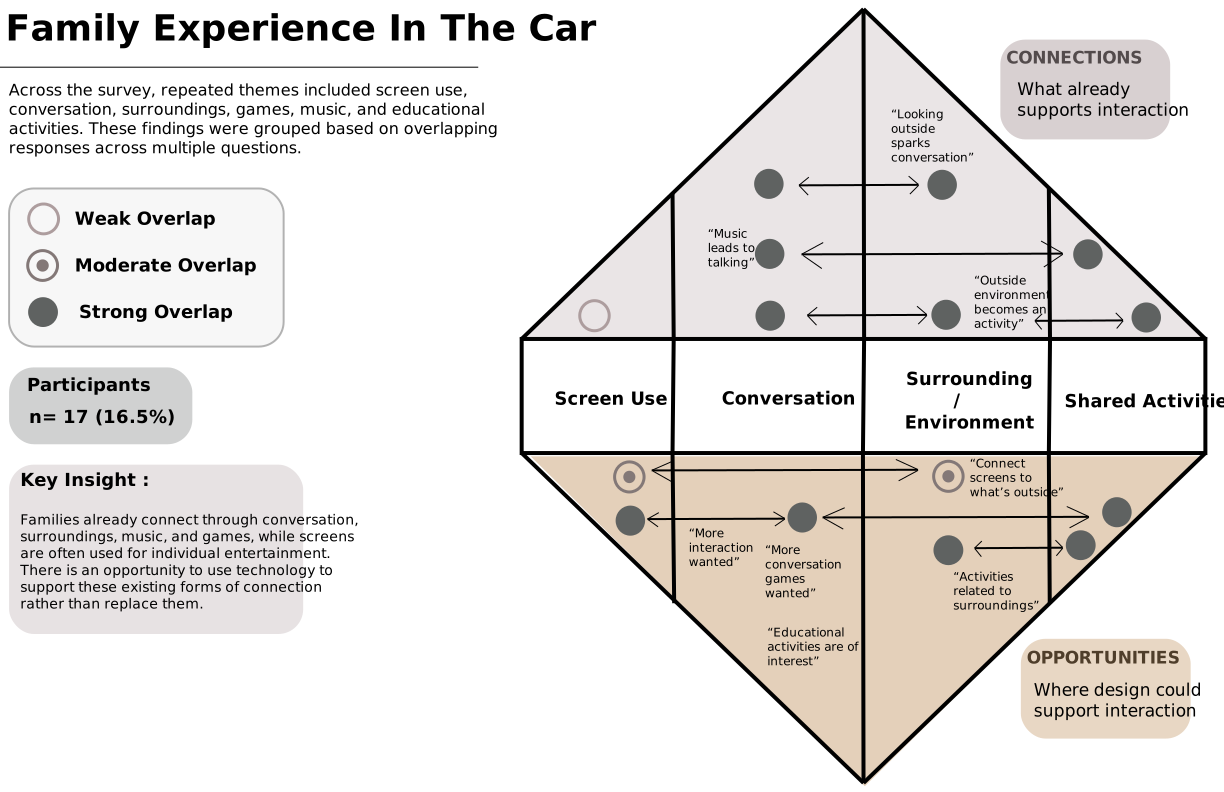
But the survey also showed another side of the family car experience. 58% said their children talk with family members during rides, and 52% said they look outside. When I asked what usually encourages conversation or interaction, 76% selected talking about everyone's day, while 64% selected looking at things outside.
The survey also revealed what families wanted more of. 64% were interested in conversation games, and 64% were interested in activities connected to the surroundings. Shared music and audio experiences were selected by 58%, while educational activities were selected by 52%. In the written responses, parents mentioned wanting more conversations, games, interaction, and looking outside.
Overall my survey didn't show me that families simply wanted screens removed, it showed me why screens are useful, what already creates connection, and what families might want more of.
Looking Outside the Window
One thing that the survey made me interested in is the environment outside the car. If 64% of participants said looking outside encourages interaction, I wanted to understand what exactly they were noticing and whether different environments changed the family experience.
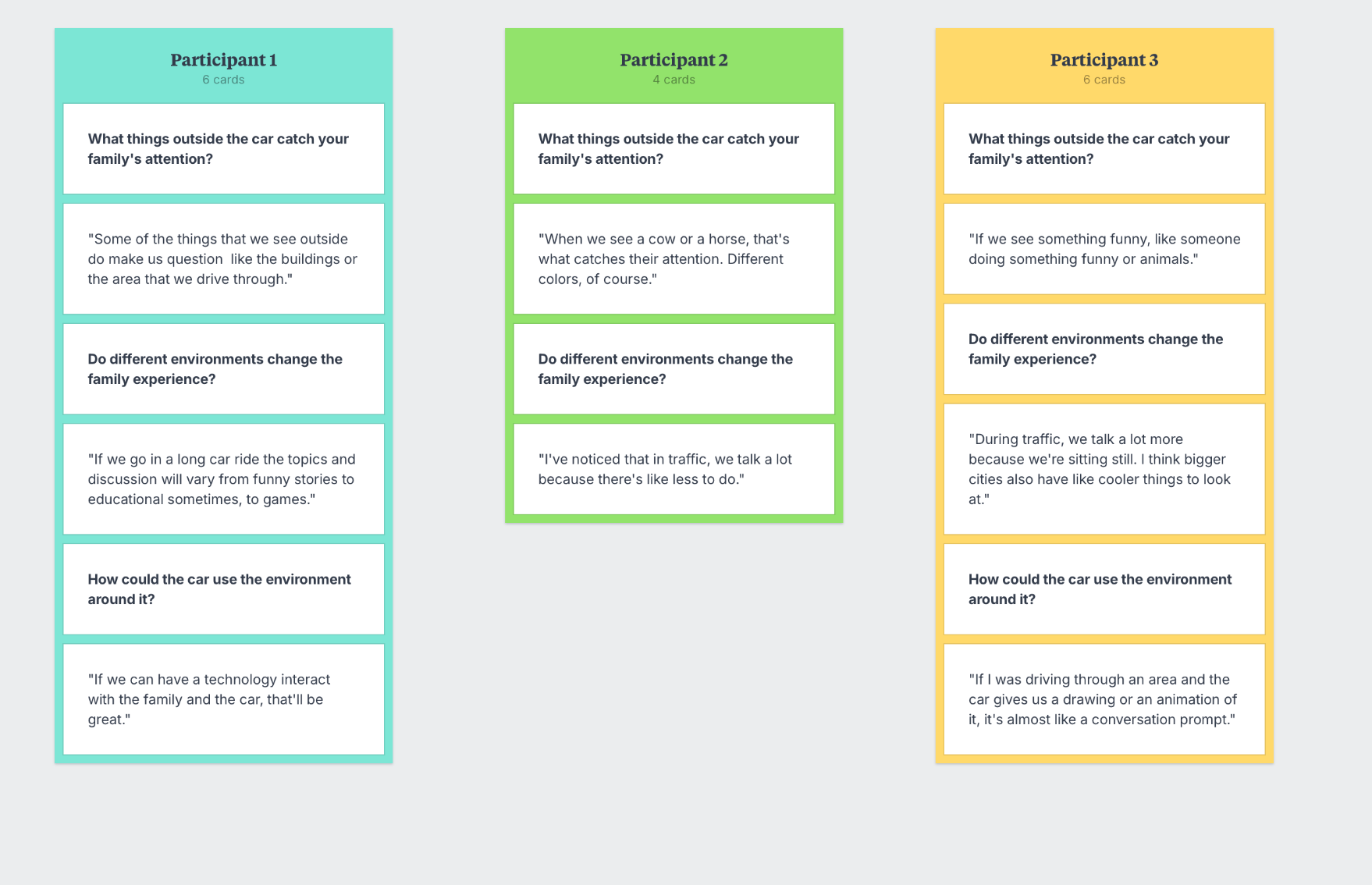
To explore this further, I conducted approximately six-minute interviews with three parents. They mentioned simple things such as animals, buildings, colors, cities, and unexpected things happening outside as things that naturally catch their children's attention.
Participant 2: When we see a cow or a horse, that's what catches their attention. Different colors, of course.
Something else that stood out to me was traffic. Two parents mentioned that their families actually talk more when sitting in traffic because there is less to do. This was ironic because I normally think of traffic as a negative part of the ride, but in this case, it sometimes created an opportunity for conversation.
I also asked how the car itself could use the surrounding environment. One parent explained that if the car showed a drawing or animation connected to the area they were passing.
it's almost like a conversation prompt.
This connected back to both my survey and secondary research. Instead of technology always taking children's attention away from the outside world, what if it could actually give them a reason to look at it?
What Could the Car Experience Become?
Once I reached this point, I started creating design concepts to explore different directions based on what I had learned.
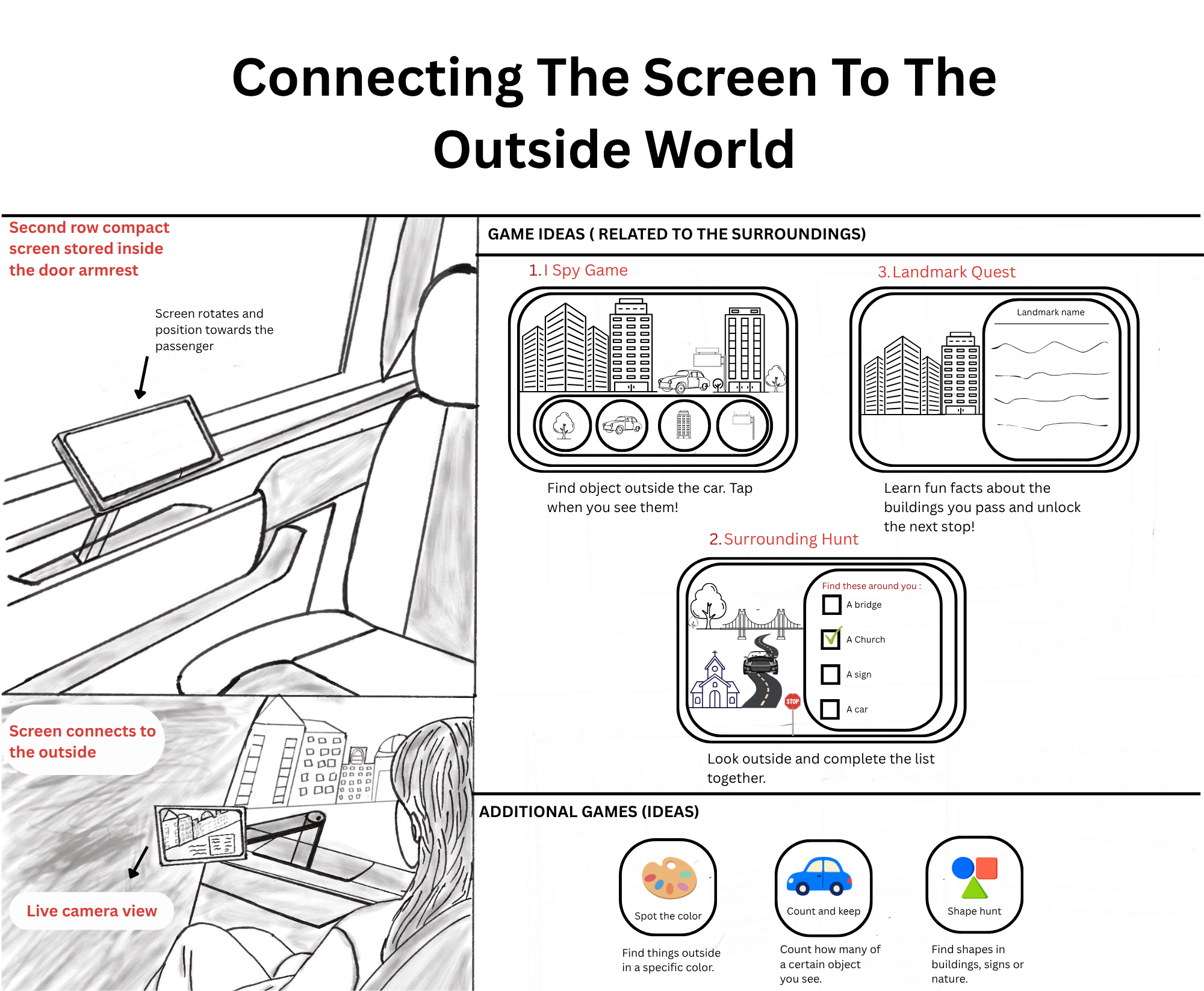
My first concept, Connecting the Screen to the Outside World, came directly from my survey, interviews, and environment research. A compact screen could be stored inside the second-row door armrest and rotate toward the passenger when needed. Children could use it for activities such as I Spy, Landmark Quest, Spot the Color, Shape Hunt, or Surrounding Hunt. Even though this concept uses a screen, the goal is not to keep the child looking at it. The screen gives them a reason to look outside. There are still some complications to consider. The screen cannot interfere with airbags or other safety features, and the games should encourage family interaction rather than individual screen use. The car’s speed could also affect how well a live camera recognizes objects or landmarks outside.
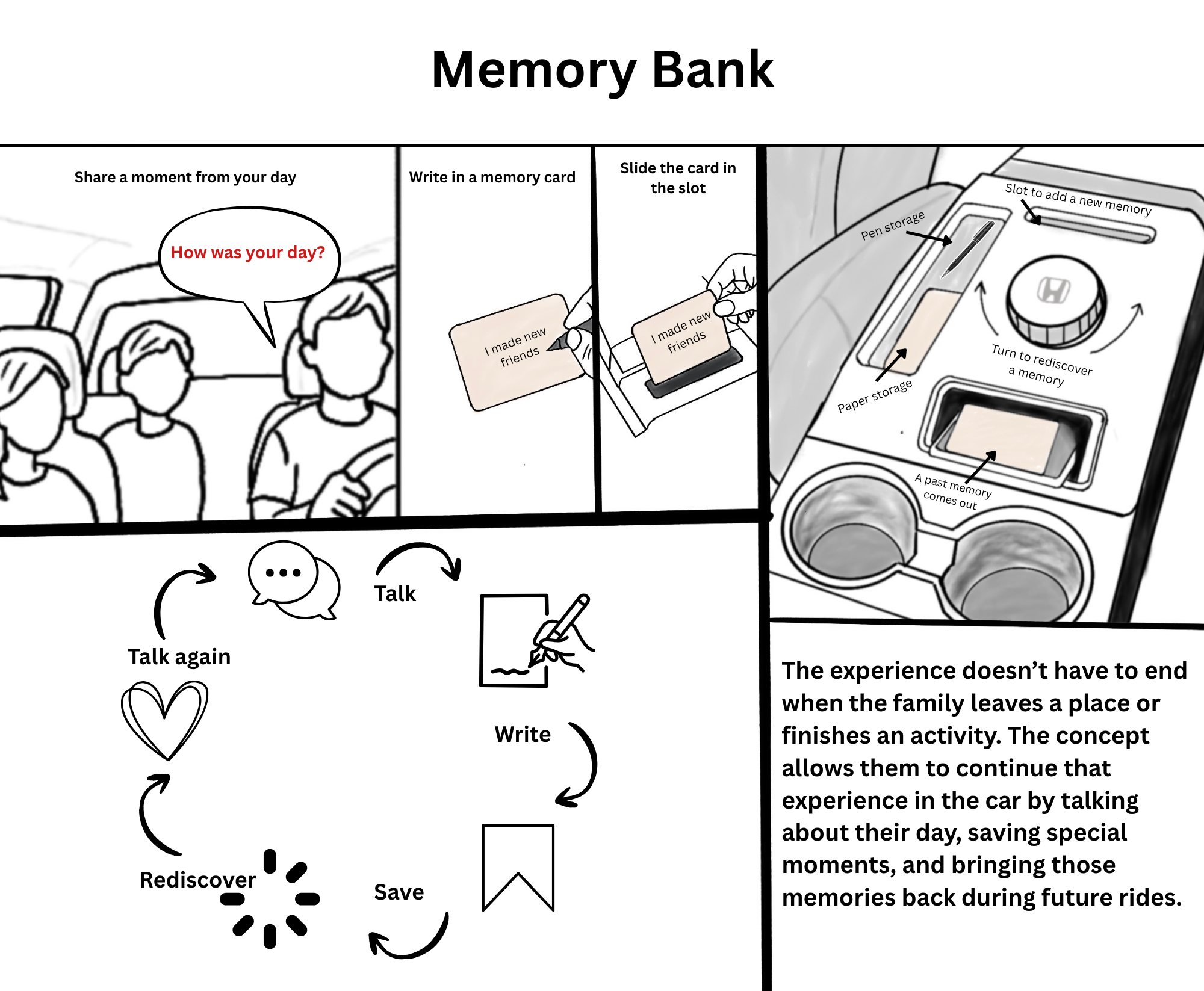
My second concept, Memory Bank, focuses on something else that kept appearing in my research: conversation. Family members could write down something from their day and store the card inside the car. Later, an older memory could come back out and become a conversation again. The experience becomes talk, write, save, rediscover, and talk again. Some complications include families losing interest over time and making sure the Memory Bank is simple enough for everyone, especially younger children, to use.
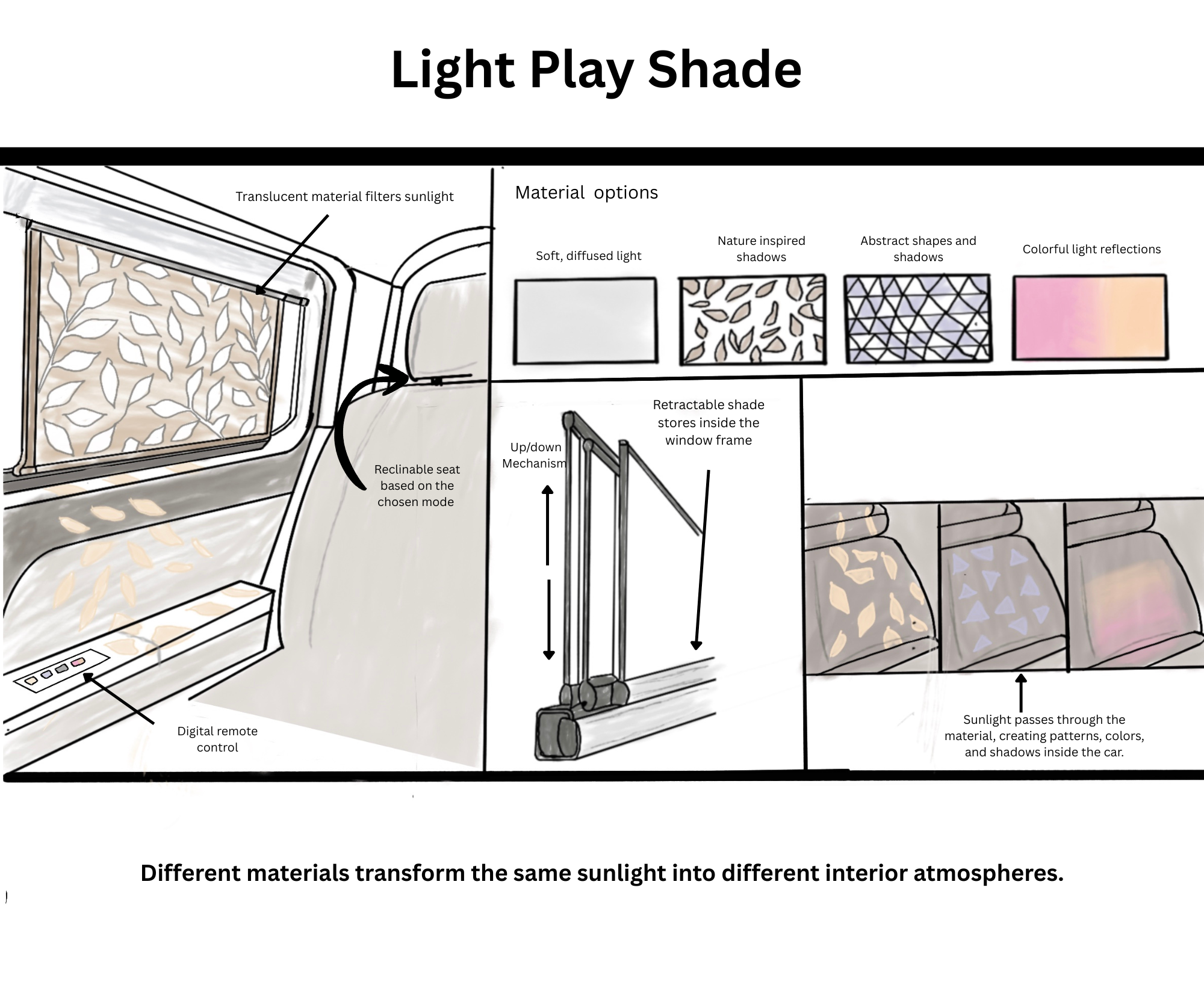
My Third concept, Light Play Shade concept explores the environment without using another digital screen. Different translucent materials could filter sunlight and create different patterns, shadows, and colors inside the car. They show how changing the material could change the atmosphere of the interior. Some complications would also need to be considered, such as driver distraction, visibility through the window, how the effects change depending on weather and time of day.
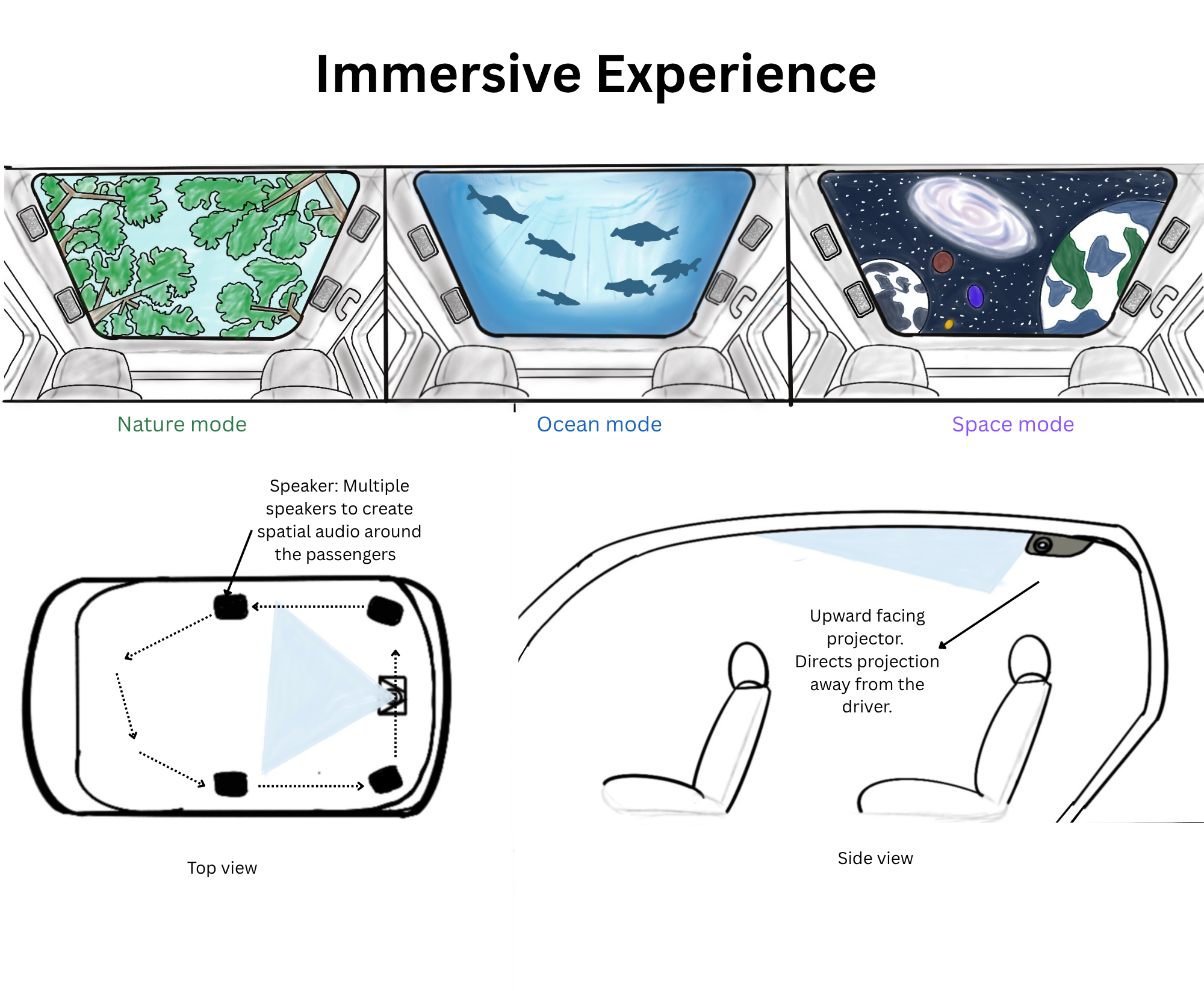
Finally, Immersive Experience came from my projection-mapping research. An upward-facing projector could create environments such as nature, ocean, or space across the roof while speakers create sounds around the passengers. Instead of everyone looking down at separate devices, the family has one environment around them that they can react to together. Some complications that would need to be considered. The moving projections could potentially distract the driver, and the projection may be harder to see during the daytime. The placement of the projector and speakers would also need to avoid interfering with visibility or Safety features.
Conclusion
When I started this project, I thought I was mainly researching how to reduce children's screen time. After doing my secondary research, survey, interviews, and design concepts, I was able to see the problem differently. The bigger issue isn't necessarily whether there is a screen inside the car. It's what that screen, activity, or environment is making people pay attention to.
A family can be sitting together in the same car while everyone is having a completely separate experience. But a conversation, song, funny moment, animal outside the window, game, memory, or even changing light can suddenly give everyone something to experience together.
I don't think technology really needs to disappear from the family car. Especially now and how the world is evolving. Instead, I think there is an opportunity to rethink what we use it for rather than only giving children something to do until they arrive. The car ride doesn't have to just be about getting from one place to another. It can also be a time for families to connect, interact, and create experiences together along the way.
Reference
Co., P. (2017, October 10). Karaoke therapy is the family bonding you’ve been missing. ParentCo. https://www.parent.com/blogs/conversations/2017-karaoke-therapy-is-the-family-bonding-youve-been-missing
Roto. (2025). Goizueta Children’s Experience | Roto Design & Build Projects. Roto.Com. https://roto.com/projects/goizueta-childrens-experience
Milk, D. (2021, February 8). Frank Lloyd Wright buildings worthy of a road trip. Frank Lloyd Wright Foundation. https://franklloydwright.org/frank-lloyd-wright-buildings-worthy-road-trip/
Using projection mapping technology to bring Van Gogh’s art to life. Panasonic North America - United States. (n.d.). https://connect.na.panasonic.com/ppnda/resource-center/using-projection-mapping-technology-to-bring-van-goghs-art-to-life?srsltid=AfmBOoqsH2YH1u9BIktM41cPJO9ub74mXkp8aJj6svJDggpXwxbNerks
Brownlow, J. (2026, January 14). Parrallel RealityTM Personalised Display Screen. World Aviation Festival - News for the aviation industry. https://worldaviationfestival.com/blog/airlines/delta-airlines-parrallel-reality-personalised-display-screens/
Driving quality, advancing the future. Honda. (n.d.). https://manufacturing.honda.com/ohio/marysville-ohio/marysville-auto-plant/
Kids entertainment tips for long US rental car trips. Hola Car Rentals. (n.d.-b). https://holacarrentals.com/fr/blogs/car-rental-united-states/keep-kids-entertained-long-rental-car-journeys-usa
CANVA: Visual suite for everyone. (n.d.-a). https://www.canva.com/
Approximately (30%) of the Op-Ed work draws from the primary and secondary research I did, (50%) reflects my analysis, insights, concept development, design decisions, and application to the family car experience, and (20%) reflects AI assistance with grammatical editing, refinement of wording and structure. All interpretations and final design decisions remain the responsibility of the author.



