
Closing the Gap Between a Medical Emergency and Trained Care

Overview
For rural Ohioans, getting medical help can mean a long journey before care even begins. While people living near a city may have access to many care points, from a local CVS to a full hospital, rural Ohioans may need to travel long distances to reach proper care. Shortages of healthcare providers and limited internet access can make that journey even harder (Jesus, 2026; Ohio Capital Journal, 2026).
Delay of care due to lack of health care resources for rural citizens is what drove the central question of my research: how can we support rural patients before they reach trained care? This includes a wide range of issues, from preventive services to how to best handle an emergency. Healthcare should not begin when a patient walks into a hospital or after waiting a long time for emergency services to arrive. A solution to healthcare in rural Ohio requires rethinking a continuous system of care, not just introducing a new technology.
Importance & Stakeholders
The main stakeholders in this solution would be rural patients. Data shows that rural Ohioans are particularly impacted by healthcare disparities:
“Rural residents are 15% more likely to die before the age of 75 compared to the rest of Ohio.”
— Ohio Capital Journal, 2026
Time is especially important in emergencies. Discussing cardiac arrest, Andrews (2024) reports:
“Every minute that passes without medical intervention decreases the odds of survival by 10%.”
— Andrews, 2024
These patients need care that can come to and adapt to them, rather than requiring them to conform to how healthcare is structured in more populated areas. The people around them, who help in daily life and may be first on the scene during an emergency, also need support. Other stakeholders include rural emergency care teams and traditional health systems, which face staffing and financial pressures while serving geographically dispersed populations (Forster, 2026; Jesus, 2026).
A design intervention could benefit all of these stakeholders. Such a device could provide better support for patients and the people around them, help alleviate pressure on rural healthcare teams, and create more efficient approaches that could help anyone reach care faster.
Secondary Research
My secondary research consisted of reviewing articles ranging from lifestyle reporting to technical medical studies.
There are many technologies aimed at bringing care to patients faster. Cleveland Clinic Flies into the Future with Beachwood Drone Deliveries describes how drones are being used to deliver prescription medication (Cohen, 2026). Another article explores drones delivering emergency equipment, including automated external defibrillators, or AEDs (Andrews, 2024). If drone technology can help people who already live closer to medical care, it could also have an even bigger impact on travel and waiting times for rural residents, depending on local resources and conditions.
Researchers at UC San Diego have been testing how large language models can support CPR instruction. Their system, ChatCPR, outperformed human dispatchers on instruction checklists when tested against recordings of previous 911 calls, including on more advanced CPR steps (University of California San Diego, 2026). As stated in the article:
“The goal is to raise the floor of performance, not to replace trained professionals.”
— Horvat, as cited in University of California San Diego, 2026
This takeaway can apply to many aspects of improving rural care. We cannot replace the resources and expertise of large hospitals, but improving how people can safely help themselves, and others, before professionals arrive could benefit rural communities.
The need to provide emergency health care service and support to rural communities and their residents is why I developed a design concept called AED+:
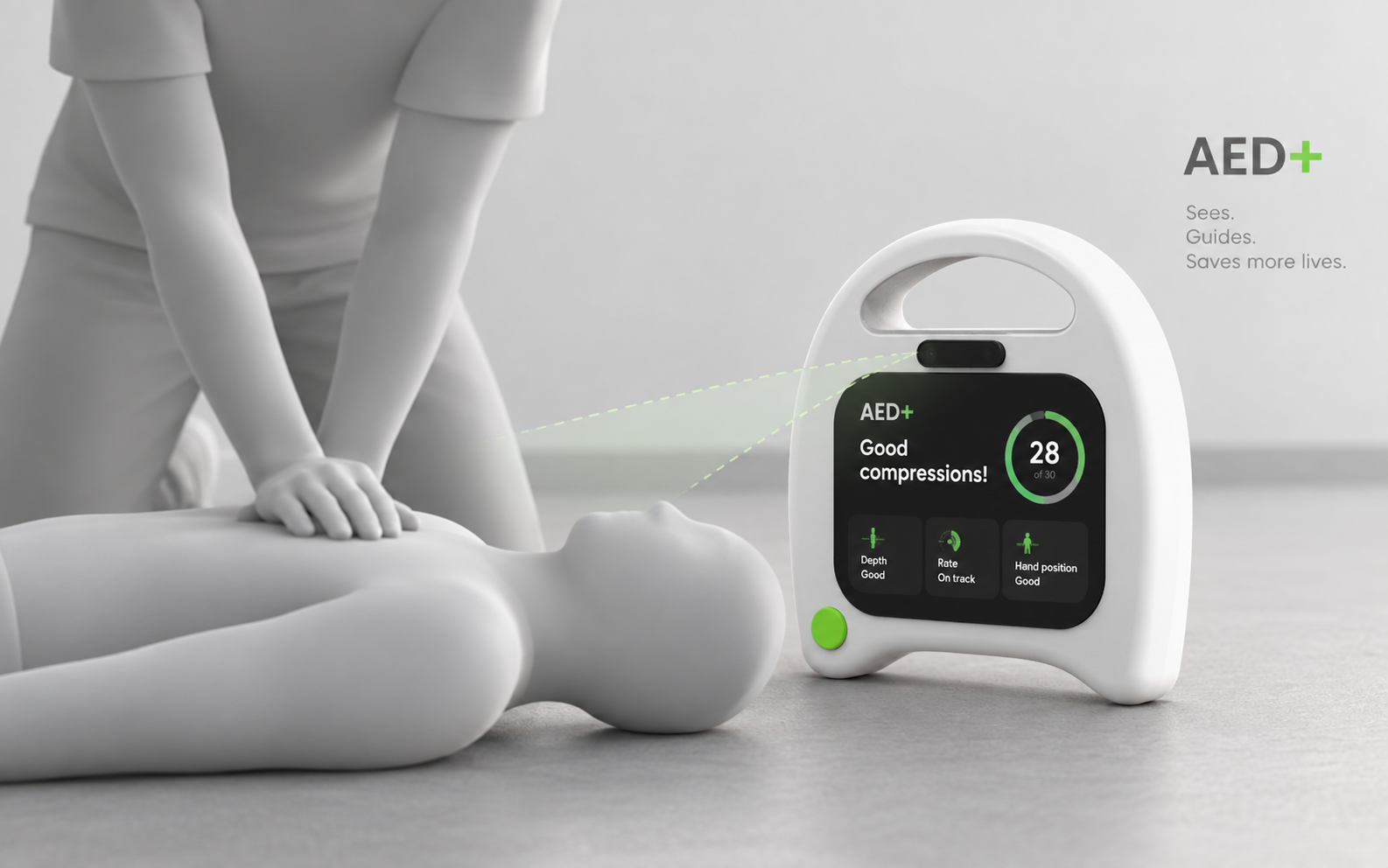
AED+ would combine guidance inspired by ChatCPR with computer vision and a traditional AED, helping bystanders follow instructions while waiting for emergency services. I would aim for it to function offline, although that capability, and the safety of the combined system, would need to be tested. The deivce could live in people’s homes or at local community spots like libraries, or even potentially be delivered by drone before emergency services arrive.
Mobile technology could also allow patients to connect with healthcare faster. My research into mobile pre-triage showed that:
“With self-service technologies, patients could complete data entry on their own, allowing nurses to focus on higher-order tasks.”
— Wang et al., 2024
Although this study focused on emergency department registration, it made me consider how similar approaches could support scheduling and sharing information before a visit. To explore this, I designed a hypothetical system using satellite messaging on iPhones called Sattlehealth:
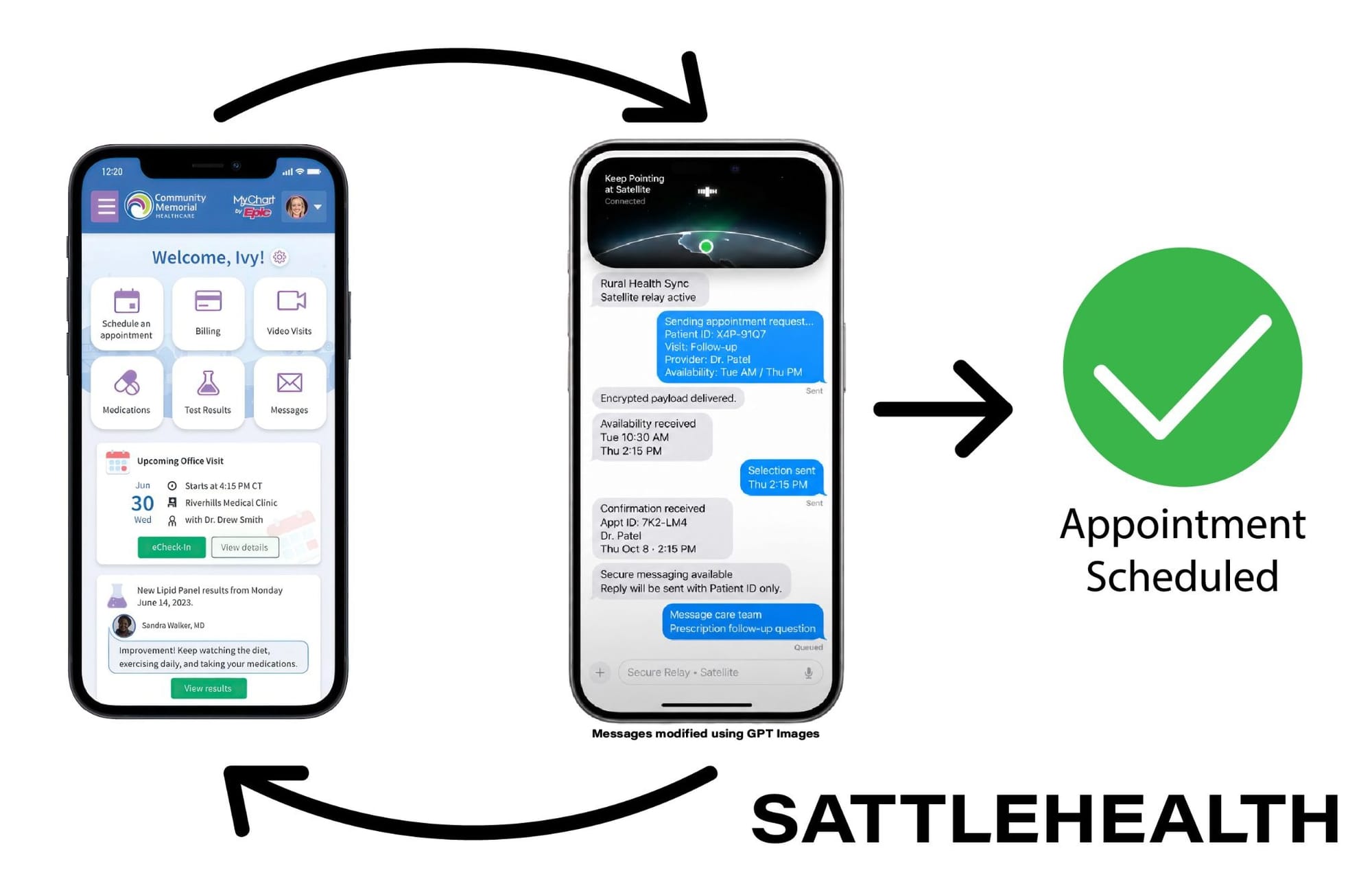
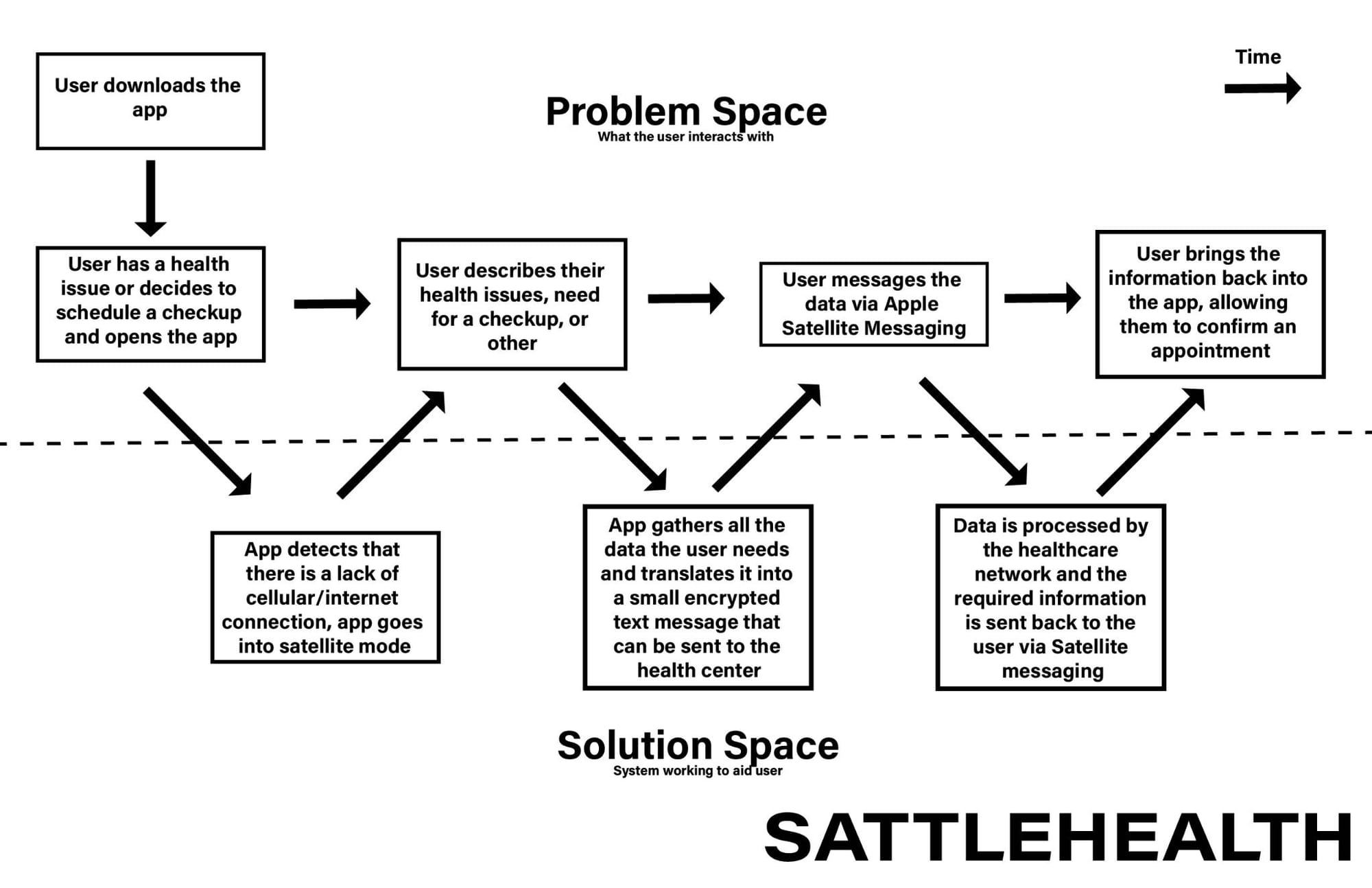
The system would use an offline app to gather crucial information and pass it securely through satellite text messaging. It would connect rural patients with scheduling and messaging services through a patient portal such as MyChart, even without cellular or internet access. Secure transmission and integration with healthcare systems would still need to be investigated. The concept builds on the importance of keeping information connected across different forms of care (Peterson, 2026).
My research also spanned areas not specifically touched upon here, from how making art can help reduce stress to the issues of trusting AI in health decisions (Han, 2024; The Ohio State University Wexner Medical Center, 2026). All of this research will impact how I consider my final capstone design.
Primary Research
To begin my primary research, I reached out to EMS and other care facilities throughout Ohio, particularly in rural areas. Six of Vinton County’s 24 EMS team members responded, so the findings provide a focused local perspective.
Vinton County Pre-Arrival Healthcare Barriers
Reading the counts: 3/6 means 3 of the 6 respondents. Barriers were selected in the survey; care themes were coded from open-ended answers.
Travel impact on care: Color shows how often respondents reported that travel time affects care: frequently, occasionally, or never.
View the full survey data here. ChatGPT assisted in making this visualization interactive from my initial drawings.
Vinton County EMS respondents connected longer waits with more serious healthcare consequences. Cell service and stress emerged as central barriers, while knowledge and basic training were identified as promising areas for improvement. This reinforced my secondary research findings about relieving stress and improving support before trained medical professionals are reached.
I also interviewed Tiago Jesus, an assistant professor in Ohio State’s School of Health and Rehabilitation Sciences whose work includes health systems research and rural disability and rehabilitation disparities (The Ohio State University School of Health and Rehabilitation Sciences, n.d.). He shared lessons from his work in rural healthcare, including older adults’ experiences with telehealth:
“They are not very happy with telehealth as a kind of solo or replacement solution.”
— Jesus, 2026, 7:37–8:13
“[Telehealth solutions] might work essentially as kind of follow-up procedures when you already have established patient relationship or healthcare relationship, and may work when there is a mediating person.”
— Jesus, 2026, 9:58–10:22
“The co-design element is very important. So have end users trying to co-design, or provide very important hints for what they want in that type of product, before it’s even designed.”
— Jesus, 2026, 16:33–16:58
Jesus shared how important the systems connecting patients to care are alongside technological advancements. He stressed that telehealth can work better when there is a mediator in the community. Specific instructions and training could help local people support others in navigating care and communicating with clinicians. This would still rely on medical professionals while keeping the connection to them personal, even at a distance (Jesus, 2026).
I also interviewed Patrick Sours, an Ohio State assistant professor whose work focuses on humanitarian engineering and water infrastructure (The Ohio State University Center for Latin American Studies, n.d.). His work emphasized how systems need to support stakeholders and clarify their roles:
“What level of responsibility do we put on the end user community?”
— Sours, 2026, 6:36
“Who are all the stakeholders and like not all of those stakeholders play the same role”
— Sours, 2026, 7:29
Sours noted that designers need to consider how much effort people are willing and able to put into a system. A key part of this is working with communities to understand their needs and the underlying problem, rather than assuming a proposed solution will address it (Sours, 2026, 9:09–9:54). Both interviews stressed how important co-design will be in my process, allowing stakeholders to determine for themselves the ideal system.
Key Takeaways
There are a few key features in a rural health solution. First, essential functions need to work offline. Ohio Capital Journal (2026) reports that 18% of rural Ohio residents lack internet access. My survey also identified cell service as a barrier. A design should account for a worst-case connection scenario, keeping instructions and information available while fully offline.
The system should also remain connected to people. My interviews with Jesus and Sours showed the importance of building around relationships, existing resources, and clear responsibilities (Jesus, 2026; Sours, 2026). This could allow services to be shared locally, connecting the community in both awareness and ability to act.
The guidance itself should be calm and clear. Jesus described developing instructions:
“how you should position the camera, and all those instructions in very plain English”
— Jesus, 2026, 13:48–14:05
My solution will need to have a tight scope to directly impact patients as a successful capstone project. Giving even a small portion of patients an additional way to access care could help relieve the system. The drone delivery example shows the value of additional options even in large health centers like the Cleveland Clinic:
“The drone service is an add-on service that just gives us more flexibility in how we take care of our patients.”
— As cited in Cohen, 2026
Providing more options for smaller rural care centers could offer similar flexibility, provided those options do not create more work than they remove.
Counterargument
A key part of healthcare’s difficulty in rural Ohio is the lack of funding and staff. Rural hospitals have to cover the fixed costs of essential services despite lower patient volumes (Forster, 2026). More devices and systems cannot replace those resources and may add costs of their own.
While my design may not solve that issue, it could help reduce friction for existing healthcare teams. It could aim to support them through financial pressures while broader funding and staffing needs are addressed. That benefit would need to be tested against the expense and work required to maintain the system. With appropriate guidance and training, it could also help bystanders provide assistance before professionals arrive, benefiting rural areas and other communities where help is needed quickly.
Conclusion
Rural patients need support before they arrive at a hospital. For my capstone, I will design a product that helps patients, family members, and bystanders respond during the wait or transit to trained care. It will provide clear emergency instructions that remain available without cellular service and help people collect essential information to share with responders when they connect. Working with Battelle, I want to test how technology can make those first steps easier to understand and carry out under stress. My goal is to give rural communities a practical way to begin care before help arrives.
References
Andrews, M. (2024, July 22). Rescue from above: How drones may narrow emergency response times. Journal of Health Economics and Outcomes Research. https://jheor.org/post/2611-rescue-from-above-how-drones-may-narrow-emergency-response-times
Cohen, L. (2026, August 31). Cleveland Clinic flies into the future with Beachwood drone deliveries. Akron Beacon Journal. https://www.beaconjournal.com/story/news/healthcare/2026/08/31/heres-how-cleveland-clinic-prescription-drug-drone-deliveries-work-plans-for-expansion-akron/91390661007/
Forster, D. (2026, July 24). An Ohio University professor’s research shows the struggles of rural hospitals are complex. WOUB Public Media. https://woub.org/2026/07/24/ohio-university-research-rural-hospitals-struggles-complex-modern-science/
Han, C. (2024, March 25). Painting as medicine: Wexner Medical Center employees reduce stress through art. The Lantern. https://www.thelantern.com/2024/03/painting-as-medicine-wexner-medical-center-employees-reduce-stress-through-art/
Jesus, T. (2026, September 21). Interview with Tiago Jesus (W. Tyrrell, Interviewer) [Interview transcript]. https://capstone-news.ghost.io/interview-with-tiago-jesus/
Ohio Capital Journal. (2026, May 8). Ohio rural healthcare access: An advanced solution. https://ohiocapitaljournal.com/2026/05/08/ohio-rural-healthcare-access-an-advanced-solution/
Peterson, J. (2026, July 24). Why hybrid healthcare is a business imperative for employers in Ohio. Dayton Business Journal. https://www.bizjournals.com/dayton/news/2026/07/24/hybrid-healthcare-business-imperative-ohio.html
Sours, P. (2026, September 14). Interview with Patrick Sours (W. Tyrrell, Interviewer) [Interview transcript]. https://capstone-news.ghost.io/interview-with-patrick-sours/
The Ohio State University Center for Latin American Studies. (n.d.). Patrick Sours. https://clas.osu.edu/people/sours.17
The Ohio State University School of Health and Rehabilitation Sciences. (n.d.). Tiago Jesus. https://hrs.osu.edu/faculty-and-staff/faculty-directory/jesus-tiago
The Ohio State University Wexner Medical Center. (2026, April 7). Public comfort with AI in healthcare falls, Ohio State survey finds. https://wexnermedical.osu.edu/mediaroom/pressreleaselisting/ai-in-health-care-2026-survey
University of California San Diego. (2026, May 18). AI-powered CPR coach outperforms 911 dispatchers in guiding bystander resuscitation. UC San Diego Today. https://today.ucsd.edu/story/ai-powered-cpr-coach-outperforms-911-dispatchers-in-guiding-bystander-resuscitation
Wang, P., Yu, L., Li, T., Zhou, L., & Ma, X. (2024). Use of mobile technologies to streamline pretriage patient flow in the emergency department: Observational usability study. JMIR mHealth and uHealth, 12, e54642. https://doi.org/10.2196/54642
Approximately 20% of this op-ed draws on the cited articles and quotations from interviews with Tiago Jesus and Patrick Sours; 55% reflects my original research, EMS survey, interviews, design concepts, initial draft, and revisions; and 25% reflects AI assistance with synthesizing sources, compiling citations, and drafting and editing prose. All interpretations remain the responsibility of the author.



